


Kiwis' baches are being contaminated by strangers' makeshift methamphetamine laboratories in a practise known among criminals as a "cook-a-batch" holiday.
Holiday-makers from hell are trawling popular accommodation booking websites to find sites to house their mobile P-labs - coating walls and carpets in noxious chemicals that can cost in the up to $50,000 to strip and decontaminate.
People are setting up makeshift P labs in Kiwi batches.
Accommodation sites assure the practise is rare, but Bookabach.co.nz encourages its hosts to insure and install anti-meth alarms.
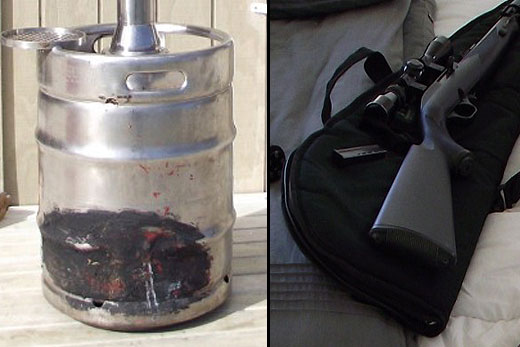
This 50-litre distillation plant might look like a home-brew beer kit but it forms a part of a much more sinister kind of "homebake."
Police found this component of a makeshift P-Lab in a bach during search warrants in Northland and the Coromandel in 2012.
P-tainted houses must be decontaminated because, according to the Ministry of Health, remnants of the cooking process at high levels may pose health hazards via inhalation or skin-contact exposure - with effects thought to include organ failure, respiratory illness, cancer, neurological disorders, and birth defects.
Massey University's most recent drug survey found users were paying about $100 a "point" (0.1 grams) for methamphetamine in 2013 - the same year police seized more than 30kg of the highly addictive drug. It is usually smoked or injected as "P" and is an attractive trade for dealers due to its ease of production and high profitabilty.
"Wellington police are aware of the use of a rental Bookabach-type accommodation we know has been used for drug related activity," says Detective Senior Sergeant Tim Leitch.
Meth cooks were attracted to booking online for the privacy factor: "TradeMe, Bookabach - anywhere you can book a house out of the view of prying eyes with a degree of anonymity and where you're not going to attract attention to yourself."
Meth Solutions owner Miles Stratford, who advises victims, says the practise was known among the criminal fraternity as a "cook-a-batch" holiday.
In the past two years his business has evaluated 2500 properties where owners suspected meth contamination, and referred about 500 for testing or cleaning.
A Rotorua client decided the decontamination cost was so great they sealed their tainted bach, saying they would deal with it later, says Stratford.
If the discovery is properly notified the title is usually added to the local council's clandestine laboratory register, and its history appears on LIM reports.
"That remaining stigma has a negative effect as far as property value is concerned."
Several families learned that the hard way, after a Northland crime family syndicate were arrested in 2012 for the practise.
Jayne Crompton, her partner Dean Theobold and her brother Marc Ethelstone booked Northland and Coromandel baches online then used their bathrooms, laundries, and kitchens, to manufacture methamphetamine, Whangarei Detective Andrew Glendinning said.
Victims later told Glendinning the trio had not appeared suspicious.
"Some did meet them and said they didn't come across as looking like they were in the drugs trade at all. They were well-spoken, well-dressed, at the time. They were nice ... polite."
But after they left some of the property owners noted suspicious signs - odd stains, a chemical smell, windows left open, or all the rubbish taken away, says Glendinning.
Five baches were examined by police - remnants of P-lab set ups were found at two and chemical traces from manufacturing at two others.
They were cleaned at great cost to the back owners, he said. No reparations were made and one family sold sub-optimally, adds Glendinning.
"It was quite a substantial loss. It affected them very, very badly."
Glendinning says he could "guarantee 100 per cent" there were more tainted baches out there.
TradeMe's head of trust and safety, Jon Duffy, says the website had provided evidence to police after one of its Holiday Houses clients' Whangarei baches was used for meth cooking in 2011.
Bookabach general manager Peter Miles says the company knew of only two confirmed cases over the past five years.
"With over 9000 properties listed and over 90,000 bookings per year the risk is small - but it is a risk. Motel and hotel operators face a similar risk ... but the added isolation and the fact there's no host/manager on site make baches especially appealing to drug criminals."
Bookabach offered some defence.
"We monitor declined credit card transactions - which can be an indicator of criminal activity," Miles says. "However, since in NZ most payments are taken 'off-line' - via internet banking -this is only so useful."
Bookabach's guest feedback system also helped - "but it can't address the problem of a criminal parading as a genuine enquirer.”
BOOKABACH'S PROTECTION TIPS
*Get a "Meth-minder" silent chemical alarm - and make it obvious - to deter cooks.
*Question requests for unusually long stays in a property in a remote location or when the weather or season isn't appropriate.
*Ensure insurance covers damage from short-term letting.
*Screen holidaymakers over the phone and trust your instinct - don't assume well-spoken, polite people are genuine.
*Appoint a local person as property manager to keep an eye on guests.
*Vet guests thoroughly via phone calls and searches on social media sites like Facebook and LinkedIn.
*Ask for a rental reference, a copy of a drivers licence, or ask whether it's ok to do a background check with their employer.

0 comments
Leave a Comment
You must be logged in to make a comment.