


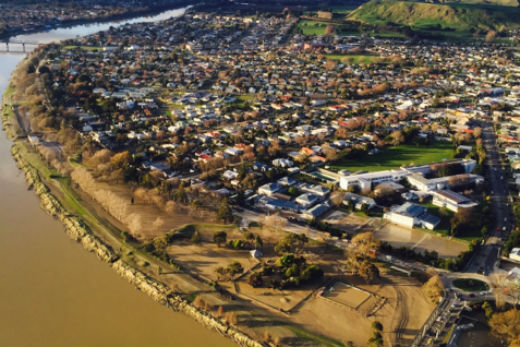
The devastation of Whanganui's 'one in a hundred year” floods should serve as a reminder for all regions to ensure their infrastructure copes with such adverse weather events, says Transport Minister Simon Bridges.
The lower North Island region this week continues its clean-up efforts after being cut off when the biggest flood in the city's records swept through on the weekend.
The flood-hit Whanganui. Photos: Simon Bridges.
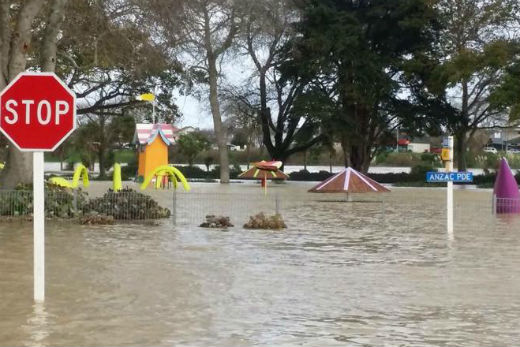
A Whanganui street underwater. Photo: Whanganui Floods 2015 Facebook
RadioLive reports more than 400 people have been directly affected by the floods with Civil Defence saying at least 30 roads, both rural and urban, were closed. Contractors continuing to work to clear a large number of fallen trees and slips.
The city bridge remains open, but Whanganui east is cut off and can only be accessed by a 40-minute detour.
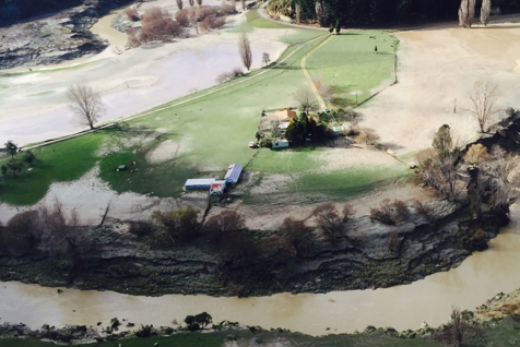
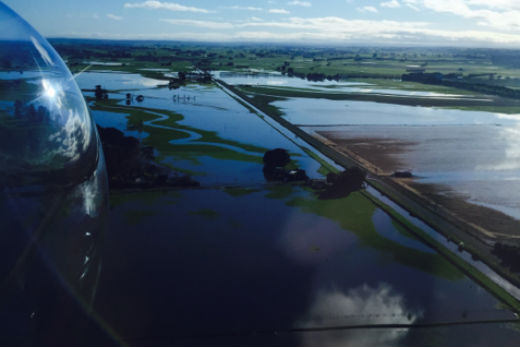
Areas are under water following widespread flooding which has also affected parts of Manawatu and Taranaki.
Rural roads near Whanganui could be closed for a month or more, while drinking water is being brought in to a small community in South Taranaki.
Yesterday afternoon Transportation Minister and Tauranga MP Simon Bridges got a first-hand insight into the flood ravaged community and the clean-up operation, where it is understood roading is one of the hardest hit areas.
He meet with Whanganui Mayor Annette Main and other community leaders.
'This is an extraordinary event for people of this region and I wanted to be there to understand and help as I can,” says Simon, speaking from Whanganui.
At the same time, Simon says it's a chance for others, including the Western Bay of Plenty, to take stock of what they have implemented should such an event strike.
'It's just a reminder, locally in the Western Bay of Plenty, that unexpected events say once in a hundred floods do happen and we need to ensure that all our infrastructure and systems are resilient and ready for that.
'It's prudent that council and Central Government are planning to have our infrastructure and systems set up the best way to future proof against serious weather events.”
During its Long Term Plan deliberations, Tauranga City Council approved $10.5 million annual funding for the first three years of the 2015-2025 LTP to progress toward stormwater alleviation and achievement of the approved level of service.
Year one sees $7.1m, year two $8.2m, year three $8.2m, and years 4-10 $6m.
Council also confirmed the establishment of a stormwater reactive reserve fund through the 2015/25 LTP to provide for relief support to flood affected landowners following intense rainfall events that result in damage to buildings and property.
The reserve will be funded from the proposed stormwater levy, general rate funded, of $2m per annum for the next 10 years.
Western Bay of Plenty District Council will adopt its Long Term Plan today where its stormwater plans will be finalised.

6 comments
Naivety
Posted on 25-06-2015 09:31 | By penguin
While Simon has a point about preparedness, he shows his naivety relating to the catastrophic nature of some events. The recent Wanganui/Taranaki situation shows that no amount of 'infrastructure and planning' can mitigate against the enormity and speed of development of some events. For example, the stop banks were built to an approx. 8m flood level, presumably based on past experience and modelling. But this flood was around 9m. Where do you set the parameters? What of the 2000 slips on the roading network and the subsequent access problems? There is also a misconception among many that the description of these events in years relates to the frequency of the event. It actually relates to the catastrophic size of the event.
Mother Nature
Posted on 25-06-2015 11:33 | By YOGI BEAR
Spend all you want, but in the end mother nature will have the last say. Look at the japan Tsunami, build a wall for 10m wave and mother nature gives you a 15m wave. Look at New Orleans, walls, embankments and Katrina had the last say. Although in New Orleans building a city below sea level defies all logic and common sense at every level. Cant complain about being flooded as a result now can we.
So gentlemen
Posted on 25-06-2015 14:00 | By earlybird
are you advocating that council's do nothing or do you spend money knowing that one day there will be an event that will overwhelm your efforts to protect people and the environment. That is the question that council officials and elected members have to ponder. What then is your recommendation?
Anything learnt?
Posted on 25-06-2015 17:42 | By Capt_Kaveman
Dont build on a flood plain
Just to Add
Posted on 25-06-2015 17:51 | By Capt_Kaveman
I dont think its fair that people pay for other peoples flood problems, my place is 400mm above the ground and higher than any other house within 1 km radius and 17m above sealevel so thats still a pretty large tsunami and as for the letter posted out what has changed from now than 50years ago? nothing the risk is the same, im tired of people like Paul who make up models to justify their space
earlybird
Posted on 26-06-2015 11:13 | By penguin
If you read my post carefully, I think you will find the answer to your question. To expand a little
Leave a Comment
You must be logged in to make a comment.