


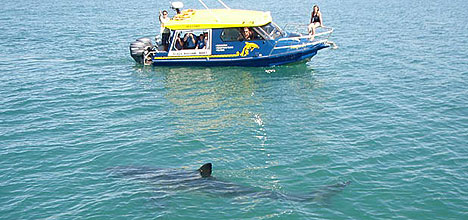
A great white shark seen at Mercury Bay on Monday is by now probably well clear of the Bay of Plenty, believes Department of Conservation shark expert Clinton Duffy.
The Whitianga shark. Photo by Kane Hill.
He says great white sharks seen swimming on the surface are in migratory mode; a low energy, high efficiency travel mode that can take great white sharks across 100-140km of ocean in a day.
The large shark photographed on the surface on Monday, exiting the Hahei Marine Reserve, was headed towards Cooks Beach and hasn't been seen since.
'The behaviour suggests it is migratory, says Clinton, who believes it is heading for either the Chathams or Stewart Island.
'At Stewart Island, when they are hunting they tend to spend most of their time close to the bottom, but when they start to migrate they do spend up to 70 per cent of their time on the surface.
'For a shark to spend that much time on the surface would suggest that it is travelling.”
The Department of Conservation tagged great whites at both the Chathams and Stewart Island and found they are two distinct populations.
'They migrate away and the ones that we have had return have returned to close to where they were tagged,” says Clinton.
'There's no movement between the two tagging areas. It suggests that each feeding area has its own population of sharks that visit that area on an annual basis.
'They migrate off to the tropics and then they come back to New Zealand to the same places.
They tagged sharks as small as 2.5m that have exhibited the same behaviour. One travelled from the Chathams to the South Fiji Basin, crossed to the Great Barrier Reef and travelled down the entire eastern coast of Australia before returning to the Chathams through Cook Strait.
'We had one that went to Fiji, Stewart Island, and Fiji recently and that was averaging between 110, 113km per day when it was travelling,” says Clinton.
They are very efficient swimmers, with one study finding great whites are one of the most efficient fish species.
They maintain their body temperature about 14-15 degrees warmer than the surrounding water, but they are nowhere near as energy hungry as a comparably sized mammal, and they don't require food quite as regularly.
An Atlantic Ocean study learned that a 4.6m male great white can travel for a month and a half on a single 30kg bite of whale blubber.
'When they are migrating or cruising like that they are travelling about 4km per hour, which is consistent with that Atlantic study and they are using very little energy,” says Clinton.
In New Zealand waters he thinks they eat kingfish, because great white sighting are often associated with kingfish.
If anyone fishing for kingies does see a big shark, Clinton's hoping they will get a photo of the dorsal fin. The fin on the Whitianga shark is distinctly notched.
And the great ‘white' can be a variety of colours, blue, brown, black or grey. The Stewart Island ones are brown.

0 comments
Leave a Comment
You must be logged in to make a comment.