


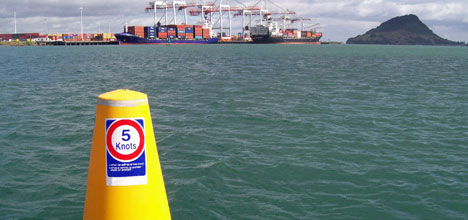
This summer, just like on the roads, it's been all about safe speed. If everyone proceeded at a safe speed there would be fewer boating collisions and drownings.
I thought you might be interested in a bit of history on boat speed and how ‘knots' got its name. But let's start with a reminder of the rule:
• The five knot rule: Does it apply to all boats?
The five knot rule says that you are only allowed to do five knots:
- within 200 metres of the shore
- within 200 metres of a boat flying the dive flag
- within 50 metres of another boat or a swimmer
- when somebody is ‘bow riding' – that is, when someone has part of their body hanging outside the vessel
The only exception is when you're in a ski access lane or a specially reserved area.
The five knot rule applies to all boats, with a few exceptions: like vessels over 500 tonnes (for example, large cargo ships) if they cannot be safely navigated at five knots; yachts racing in a club race; competitive rowing or paddling; or any police, harbourmaster or emergency craft.
• So how fast is five knots?
- Five knots is about the same as a very fast walk – check out the people walking along the beach to get some idea of how fast you can go.
- It's around 10 km/hr (9¼ km/hr, actually, which is very slow!) Imagine driving your car at 10 km/hr and you'll get some idea of how that feels
- If your boat or jetski is measured in miles per hour, five knots is just under 6mph, so knots are roughly the same as miles per hour
- A horse walks at roughly 6-7mph, which is just slower than five knots – trotting speed is way too fast!
- A decent kayak paddler can manage around 10km/h – or five knots – so if you're travelling faster than a sea kayak or multisport kayak, you're exceeding five knots.
• What exactly is a ‘knot' anyway?
A knot is a nautical mile per hour, so a boat travelling at five knots is moving at five nautical miles per hour. A nautical mile actually relates to the circumference of the earth. If you divide the earth up into 360 degrees, then break one of those degrees into 60 ‘minutes' then, at the equator, a ‘minute' – or 60th of a degree, equals a nautical mile.
• How did knots get their name?
The answer goes way back to the 17th century. On the old sailing ships, there was no GPS or other way to measure speed or distance.
The sailors devised a way of measuring their speed through the water by throwing a ‘log' or triangle of wood into the water with a piece of rope tied to it. They would time how fast they sailed away from the log using an hourglass and when the hourglass sand ran out, they would stop the rope and measure how much rope had been fed out.
The rope was tied with knots at regular intervals, to make it easy to measure how much rope was used. Distance between the knots depended on the hourglass: if it ran for one minute, simple mathematics tells us that their knots would have been 101 feet (or 30.8 metres) apart.
The sailors just counted how many knots had been fed out – and that gave them their speed – in knots.
• Make your own speed log for fun
You can make one of these easily and test it out for yourself. Make the ‘log' from a triangle of ply. It needs to be weighted along one side so that it floats vertically in the water. You will need to attach it to a long rope with a three legged bridle, one end to each corner of the log. One bridle leg should be attached to a cork fitted into a hole drilled in one corner of the log. This allows you to easily retrieve the log when you've finished – just tug hard on the rope and the cork will pull out and the log will turn sideways. Tie knots in your rope at regular intervals. If you're timing for say 20 seconds, your knots would need to be 10 metres apart.
I tried it many years ago and it was surprisingly accurate – and rather fun, too. Try it with the kids sometime!
• In a car, you always have to keep left: in a boat, it's the opposite – you have to keep right! Why is this?
This is historically because before the use of a rudder the boat was steered by a steering oar, which was located on the right-hand side, (also called steer-board, or starboard side of the boat) because the helmsman, standing in the middle of the boat and looking ahead, used his right hand to operate it.
Traditionally, boats would moor with the left-hand side to the wharf to prevent damage to the steering oar, and this was referred to as the larboard or loading side. This was later replaced by the word port (the side used when in port) to prevent confusion from the similar sounding words larboard and starboard.
By keeping to the right, boats pass ‘port-to-port'. This protects the vital steering oar.
• Do jetskis (personal water craft) have to obey the same rules as big cargo ships?
Yes, all water craft have to obey the same rules. Our rules are based on international rules, so if you're out in the open ocean, all ships and boats should be using the same rules. Jetskis (PWCs) obey the same rules as everybody else: they have to keep right in a channel; give way to the right when there's a crossing vessel; keep a good lookout, obey the five knot rule, and so on.
• Where can boaties go to find information on safety regulations and local information?
Call in to the harbourmaster's office at 6 Rata Street, Mount Maunganui and collect a free Tauranga Harbour or Rotorua Lakes Guide. We also have Harbour Guides for Whakatane, Ohiwa and all the river entrances between here and Opotiki. Or visit www.envbop.govt.nz and look under environment.

0 comments
Leave a Comment
You must be logged in to make a comment.