


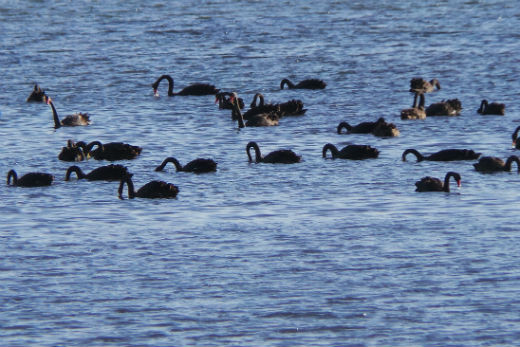
Black swan numbers on Tauranga Harbour are sustainable, according to Eastern Region Fish and Game, and there is no need for a cull.
Increased monitoring of black swan numbers in the area indicates the population is sustainable and not out of control.
The number of black swans in Tauranga Harbour does not require a cull, says Fish & Game. Photo: File.
'Our counts indicate the swans don't appear to be the problem they've been painted in some media and other reports,” says senior Fish & Game officer Matthew McDougall.
'There's evidence that numbers rise for only a small part of the year, so we see no need for any immediate drastic controls.”
Fish and Game staff increased their monitoring of the black swans in the harbour in response to public calls for the numbers to be reduced.
Monitoring included aerial counts carried out at different times of the year using light aircraft.
Black swan populations fluctuate according to the season. The numbers decrease in autumn and winter and increase again in spring and early summer.
In January this year, there were less than 6000 birds – a figure which fell away to 800 August.
'We've known for some time that black swan move away in about May to areas such as the Rotorua and Waikato lakes,” says Matthew.
Any move to cull or control the birds on Tauranga Harbour could harm Waikato populations which have already taken a 'huge knock” from the disappearance of weed beds in that region, adds Matthew.
Black swans are native birds and the harbour is part of their natural habitat.
If sediment flows into Tauranga Harbour were reduced through more catchment protection measures, the seagrass beds important to juvenile snapper could easily cope with the black swan numbers.
'Initiatives such as fencing streams and planting, like the work spearheaded by the Whaingaroa Harbour Care group in Raglan, would be very beneficial,” he adds.
The Eastern Fish and Game Council, which manages sports fish and game birds in the region, is responsible for keeping populations to a manageable size so they don't have a detrimental effect on the environment or users of the harbour.

9 comments
Black swan
Posted on 09-09-2015 16:32 | By Kenworthlogger
The article is not entirely correct. The black swan was hunted to extinction in NZ and Has been reintroduced, more than likely from Aussie.
Another joke!!!
Posted on 09-09-2015 16:43 | By sambo's back
Black Swans a native bird???, that is very questionable, Pukekos are native to our country and as such much to our annoyance at times are protected as they should be, these huge birds should be classified as a pest like Canada Geese, and as such should have an "open season" tag stamped on them, we would be doing the Rotorua lakes and Waikato wetland areas a huge favour by culling their numbers too a manageable level, zero sounds like a good figure, an absolute cop out, and maybe a few of these experts can live around our harbour and pick up the dead sea grass and the ridiculous amount of effluent produced by these heinous birds, a native bird..... rubbish, or prove it!!!
NOT NATIVE
Posted on 09-09-2015 20:17 | By The Caveman
Black swan are NOT native to NZ - they are an introduced Aussie from 100+ years ago. @By tonyb - back in the 60's there were VERY LARGE SWAN DRIVES on the harbour where their numbers were in the 20-40,000 and they were totally "killing" the upper harbour. Over a weekend 10,-15,000 would be shot and the numbers kept to a reasonable level. It appears that they have now got to a totally un-manageable level.
huh tony
Posted on 09-09-2015 21:05 | By Capt_Kaveman
black swans are native to the southern hemisphere, some of the Rotorua ones were shipped to south America to repopulated were they became extinct, as for Pukekos well they came from oz and prob been here longer than the Maoris
kind of native
Posted on 09-09-2015 21:45 | By Darren
"Before the arrival of the M?ori in New Zealand, a subspecies of the black swan known as the New Zealand swan had developed in the islands, but was apparently hunted to extinction. In 1864, the Australian black swan was introduced to New Zealand as an ornamental waterfowl, and populations are now common on larger coastal or inland lakes, especially Rotorua Lakes, Lake Wairarapa and Lake Ellesmere, and the Chatham Islands. Black swans have also naturally flown to New Zealand, leading scientists to consider them a native rather than exotic species, although the present population appears to be largely descended from deliberate introductions" https://en.wikipedia.org/wiki/Black_swan#Introduced_populations
Better interpretation
Posted on 09-09-2015 22:58 | By Silent Lambs
F&G need more time to figure a way to be able to run a Bonnie and Clyde type shot out on the harbour on an array of gun boats and the like and not be labeled as murders and heartless. A tall order indeed to come up with a cunning plan to get it all done.
Joke is right !!
Posted on 10-09-2015 11:09 | By milka
We opened a swan to see what they were eating 3 baby snapper & 1 baby flounder from one swan think about how many there will be from 6000 but hey fish and game don't get a licence fee for those do they!! They also get more publicity from blaming farmers for sedimentation it is about time people saw fish and game for who they really are
@Capt_kaveman...
Posted on 10-09-2015 16:49 | By sambo's back
Black Swans back in the day when nights where bold, where considered a delicacy and many a picture of banquet tables laden with roasted black swan abound, so they where introduced first to that "penal colony" across the ditch, then onto NZ, now if as some are suggesting they flew here with no hitch hiking on a sailing ship, they must have had enormous auxiliary fuel tanks!!!!, I say go back to medieval times and roast the bloody lot of them, as far as eating one goes, I would not lower myself, and a choice between eating possum or black swan, me thinks I would choose the possum!!!.
Black swans are a tourist attraction
Posted on 28-10-2017 17:15 | By Robert Curtis
There is no evidence that black swan were hunted to extinction. Lack of records are sighted as evidence. There is evidencw. They arrived here naturally and may continue to do so. Sighted at 10,000 feet. The arguments around introduced, native, and there are others are all tied up with politics. The ships that arrive here filled with tourists like seeing black swans. Think of the financial benefits of habour tours. Magnificant birds. They also eat sea lettuce which helps prevent blocked water intakes.
Leave a Comment
You must be logged in to make a comment.