


A new online portal for healthcare workers is launched in the Bay of Plenty with Minister of Health Tony Ryall saying the Bay Navigator will help provide ‘Better, Sooner, More Convenient healthcare'.
In his speech given at Bay Navigator's launch Tony talked about how the web portal will assist in providing guidance for the best treatment path for certain patients.
'This is using the power of the internet and agreed protocols to give patients a better deal by doing a better job of helping them to the right service at the right time, faster and closer to home,” says Tony.
'Together, the Bay's own hospital clinicians and general practitioners will be developing clinical pathways to fit Bay of Plenty needs – starting with child health, cardiology, respiratory and diabetes.
'It will mean GPs will be able to go online and get step by step guidance agreed by clinicians on how these conditions should be handled, and what the GP should do.
'That will assist primary care to do more for their patients in their clinics, more quickly, and refer fewer patients on to the hospital.
'We are determined to give New Zealanders better access to a wider range of services in primary care – and to take the pressure off our hospitals.
'In other DHBs, who are further along this road, new clinical pathways are making a real difference.
'For instance in Canterbury, as part of the so called Canterbury initiative, they are moving services from hospitals into the community with very good results.
'Feedback for the equivalent work in Canterbury is that participants really enjoyed re-engaging with colleagues across primary and secondary care.
'That's because the key to developing Bay Navigator will be the contribution of GPs and hospital doctors meeting together and discussing best care for patients.
'One piece of feedback I'd pass on is the benefit of including nursing in the development of care pathways.
'While there's going to be a robust discussion between doctors, nurses as part of the multi-disciplinary team could be involved earlier.
'GPs and practice nurses in Canterbury tell me that it is now so much easier to quickly go into the website during a consultation when the patient is there with them in the clinic.
'It allows a GP to take the right history and do the right examination to ensure the appropriate clinical information is in the referral letter.
'It also allows the GP to give a patient some indication of whether they'll be seen in a hospital or a clinic and what else can be done to assist the patient.
'A Canterbury GP told me that in conjunction with his practice nurse, he started someone with Type 2 Diabetes on insulin recently, and found it wasn't as difficult as he thought it would be.
'Previously he would have referred the patient to a hospital diabetologist to do this.
'The same GP has used the respiratory services a few times and found it excellent for his patients.
'Several GPs told me that they have found the best part of these care pathways is seeing primary and secondary clinicians working together for patients, promoting best care through clinical leadership.
'And it's all about better, faster services for patients.
'For example – a young Canterbury woman came to her GP with a lump on her eyelid. The GP looked up the clinical pathway which said the lump would be low on the priority list for referral, but it provided clear guidelines for him to remove the lump himself.
'The pathway also reminded him that sometimes these lumps are not benign. And once he'd removed it, it didn't look normal.
'So he sent it to histology. A week later the lab reported the lump was in fact a tumour. So he referred his patient on to an ophthalmic plastic surgeon who was able to see her as a high priority.
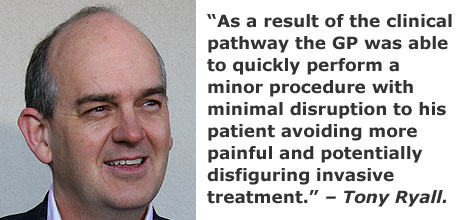
'As a result of the clinical pathway the GP was able to quickly perform a minor procedure with minimal disruption to his patient avoiding more painful and potentially disfiguring invasive treatment.
'The GP was confident because he knew the pathway was designed and approved by local specialists working with general practice clinicians. It was based on best practice and made the best use of resources.
'The patient was reassured because the GP had up to date information at his fingertips – allowing him to keep her informed throughout the treatment journey.
'Engaging with new clinical pathways between primary and secondary is making a positive difference to Canterbury hospital specialists too.
'Hospital gynaecologists say GPs taking on more in the community for women with gynaecological problems is freeing them up to see those women who really need to be seen – and in quicker time.
'Women with a gynaecological condition used to face long and uncertain waits to see a specialist and were frequently unable to get a publicly funded ultrasound scan before their outpatient appointment.
'They had to go away, have the scan, sometimes months later, and then return – after a further wait – to see the specialist.
'This was worrying for the patient and risked more delays in the diagnosis of serious conditions including cancer.
'On the new pathway, a woman is told – on her first visit to her GP – whether or not she meets the criteria for ultrasound scans and specialist appointments.
'If she does meet the criteria – she can now get her scan much faster.
'If she needs to see a specialist she can in a more appropriate time frame.
'Or her GP can quickly carry out any other procedure needed in the clinic.
'The speed and availability closer to home of these diagnostic services is clearly more reassuring for the patient.
'The process includes excellent communication channels between the hospital and general practice as well as good information sources for women.
'This new pathway at Canterbury has taken months out of the journey for some women from presentation at their doctor to definitive treatment of their condition.
'Canterbury people with miserable joint and muscle aches and pains are also now finding much speedier relief.
'In the past many patients presenting at general practice in Canterbury with painful conditions like bursitis and neck and back pain couldn't see the orthopaedic surgeons because they were fully occupied with major surgery such as joint replacements.
'Their GPs frequently needed assistance to best manage these patients but they couldn't get a response out of the hospital.
'The new clinical musculoskeletal pathway online provides written guidance on the conditions most often referred or asked about.
'It also has a central contact point managed by a liaison GP and an orthopaedic surgeon who can provide more detailed advice and help.
'They can provide written management and expert clinical advice, provide ultrasounds and scans, and make appointments at the musculoskeletal clinic, pain management service, or orthopaedic service.
'In other words, make sure the right patients see the right services at the right time.
'Many of these conditions are miserable to live with day after day and readily relieved by the right treatment given promptly.
'Much better for patients – and a much smarter more efficient use of the health dollar.”

0 comments
Leave a Comment
You must be logged in to make a comment.