


The calls for the New Zealand government to echo the UK's ban on sugary fizzy drinks is not being supported by Tauranga life coach and author Leigh Elder, who says the science on taxing things is not convincing.
'We don't think making selected food and drinks unpopular is the right way to go,” says Leigh.
The UK's new sugar tax could prove a tipping point internationally.
Leigh is the author of Eat For Keeps, and helps people through weight and diabetes issues with education about nutrition.
'Our stance is, if you go into a supermarket with 30,000 different food and drink items they are all biologically safe. So what our view is we want people to learn how to actually manage their way around there, make the right choices.
'We are very much in the knowledge is power camp. That worked really effectively for us.”
While raising taxes on sugary drinks could be useful, the bottom line is what have people learned? Says Leigh.
But the issue has raised awareness.
'It's a pretty big thing and Jamie Oliver's done well.”
Chef Jamie Oliver is been a key player in the campaign calling on the British Government to announce the tax on sugary drinks, the proceeds of which is says will be spent on children's sport.
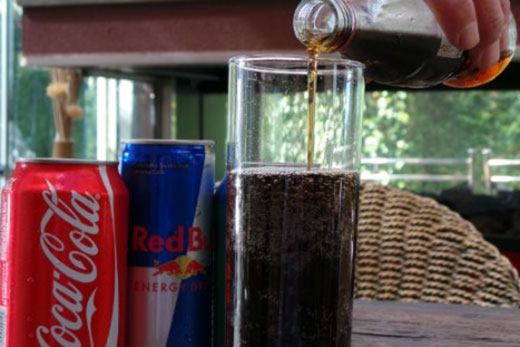
Fizzy drinks: more than a spoonful of sugar.
The UK Government outlines plans in the 2016 budget this week to 'introduce a new soft drinks industry levy to help tackle childhood obesity, by incentivising companies to reduce the sugar in the drinks they sell, to fund a doubling of the primary schools sports premium to £320 million per year from September 2017.”
The Science Media Centre has collected comments from a number of experts.
"We (health professionals/researchers and FIZZ (Fighting Sugar in soft Drinks) see this move as very positive and think it will make the possibility of a similar tax being introduced far more likely here in NZ,” says Senior Research Fellow, School of Population Health, University of Auckland, Dr Gerhard Sundborn.
"It is great to see the UK government being bold and showing strong leadership. It signals that obesity as an issue in the UK is being taken seriously by addressing it with meaningful policy.
"We hope this will encourage our government to follow suit."
Professor Tony Blakely, Department of Public Health, University of Otago, Wellington, says the UK tax recognises that we have transitioned to a world where obesity is a major public health threat, and that society needs to take collective action to alter its direction of travel.
'The tax will lower sugary drink consumption, not only through a ‘signal' to consumer pockets, but also by changing industry behaviour,” says Tony.
'It is all well and good to promote individual choice and responsibility – this matters. But so does ‘resetting' the food landscape to be healthier.”
Dr Stefanie Vandevijvere, Senior Research Fellow, School of Population Health, University of Auckland, says the UK tax might even prove to be a tipping point to get more similar actions happening internationally.
Dr Simon Thornley, Epidemiologist at Auckland Regional Public Health Service, says sugar needs to be treated like tobacco with progressive tax increases.
'The situation in NZ is very similar to the UK with high levels of childhood and adult obesity. As well as limiting weight gain, this tax is likely to lead to major savings on children's dental health,” says Simon.

8 comments
Not for sugar.
Posted on 19-03-2016 12:57 | By astex
The increase in tax on tobacco worked because there was no alternative product to change to so is irrelevant in this case. Until the cost of soft drinks is more than the cost of milk etc no-one will change. If the governmenbt is serious about the problem the subsidy on milk will be re-introduced to make it more affordable. Iwith the world milk crash it should be cheaper anyway). Also other products have very high sugar content because producers have worked for years replacing high cost ingredients with sugar to increase profit. If a sugar tax is introduced it needs to be on everything, or maybe sugar content on certain foods should be restricted.
Sugar
Posted on 19-03-2016 14:13 | By Crash test dummies
the cost economically from sugar is huge, maybe more harmful to more than smoking and booze combined, so why not tax it. Sugar is the likely reason for the largest part of health costs, health issues in all and more.
What worries me about this...
Posted on 19-03-2016 14:19 | By morepork
... is that it is tantamount to saying that rich people can do whatever they like while the rest of us will be penalized to set us straight. I learned long ago that if you keep an eye on sugar, fat, and salt in your diet, it isn't hard to avoid excessive weight. Taxing things like cigarettes and sugar is a "brute force" way to make people avoid them and it only works with people who have to consider how much they spend; the very rich don't care... The real solution is to get yourself informed on what is good and bad for you and apply common sense. YOU are responsible for the condition YOU are in and government disincentives should really make no difference.
Why me
Posted on 19-03-2016 14:52 | By The umpire
I don't think I should be taxed so you fat barstarts who can't say NO can drink yourselves obese and clog up the health system. If we all opted for low sugar drinks the company's would alter their output accordingly.
Yes
Posted on 19-03-2016 17:26 | By Tyraone
Tax sugar! Could reduce obesity, diabetes, and all sorts of other nasties. Come on NZ follow the UK example!!!
@ iknow
Posted on 19-03-2016 22:49 | By Crash test dummies
Actually the tax should be on sugar, not sugar in fizzes. A broad attack here is a good idea. Yes the price of milk should have dropped but not so, such is the corporate grab for profits at any cost.
@ morepork
Posted on 19-03-2016 22:51 | By Crash test dummies
Of course tax is a "brut" force approach, that is what is needed for simple folk to get the message loud and clear. Perhaps the tax on Sugar should then be used to reduce the cost tot eh taxpayer of all this harmful stuff?
@Jaffa
Posted on 21-03-2016 12:53 | By morepork
I think you missed my point: Personal responsibility is the only effective way to decrease obesity in children (the parents are responsible) and in adults. Education at an early age, not another tax that only affects poorer people (rich people don't care...). I'm not actually opposed to a sugar tax, (maybe as an interim measure, to make many people think twice), but my concern is that it is being presented as a solution, when it really isn't. This kind of "taxing people for their own good" is NOT a solution in itself;(not for booze, not for cigarettes...). it is individual decisions that decide the final outcome and these are best effected by making sure people are informed and supported when they decide to quit. If you REALLY believe that something is evil for people, why not ban it altogether? Been tried, doesn't work. Inform and persuade future generations.
Leave a Comment
You must be logged in to make a comment.