


Mrs McGlashan was probably quite chuffed.
Six-year-old Jayden Crowley strolls into her Te Puke Year 1 classroom one morning and presents the unsuspecting teacher with a big bunch of freshly-picked dahlias. Pink, yellow, crimson, purple.
Allergic to dahlias.
What a touch; what charm. Big showy blooms, a riot of colour, flowers of mystery and romance. And in this case, flowers of abiding respect for a teacher.
But there's a dark side to dahlias. 'They're well recognised as a cause of skin allergies,” says Bay of Plenty District health Board paediatrician Justin Wilde.
But not well recognised out in Number 1 Rd, Te Puke, where a spectacular blaze of dahlias lined the roadside outside the Crowley's orchard farm.
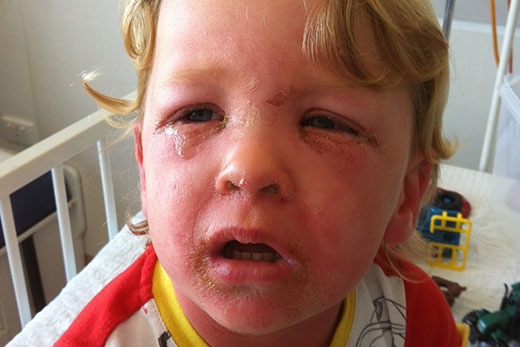
'A few days after picking the dahlias for the teacher my other son, two-year-old Dean was lying in a hospital bed,” says mum Rowena Crowley.
'His eyes were swollen shut, his skin was red and peeling like he'd been burned; and he was so sore he screamed when you touched him.”
No-one could quite nail the cause. But Dean was sick, miserable and on morphine.
'Thankfully, all his vital signs were fine. His breathing was fine. The problem seemed an external one.”
Rowena wants to make it clear from the outset she's not complaining. 'We're very grateful for the care and help the hospital's children's ward gave to fix our poor little man. They were wonderful.”
But she and husband Mark hope sharing their experience will mean greater awareness.
Ten years ago, the Crowleys planted 30 metres of Dahlias as a roadside border. 'It was beautiful, spectacular and I always looked forward to them flowering,” says Rowena.
And each day, twice-a-day, Rowena, Jayden and Dean would wander past the dahlias to put Jayden on the school bus and then to meet him off the school bus.
'Dean watched us picking flowers for Mrs McGlashan and copied us,” says Rowena. The mischievous two-year-old ripped heads off the dahlias as a two-year-old would. 'He was just having fun.” But it wasn't fun. It was the revenge of the dahlias.
Dean developed a red tinge around his eyes and then a red rash. The doctor prescribed antibiotics. Dean's conditions raged on. A different doctor would give him different meds to kill off the problem. It was an allergy but an allergy to what?
'At that stage I thought it might have been a reaction to rice from prawn sushi,” says Rowena. A blood test eliminated that possibility. What's even more curious is Dean would get better then relapse. That coincided with trips back and forth to the bus stop past the dahlia patch. But it wasn't that obvious and no one picked it.
Recently, Rowena had changed from using washing liquid to washing powder. Was that the catalyst? She reverted and washed all Dean's laundry in liquid again. The process of elimination continued.
Then the Crowleys made a night-time trip to A&E and a return trip with stronger antihistamines. The following night Dean looked like he'd been scalded.
'You just couldn't touch him without him screaming,” says Rowena. A very sad little boy was taken to hospital and admitted. 'You don't blister for nothing,” says Rowena.
They thought he might have something called Staphylococcal Scalded Skin Syndrome – quite an infectious skin disease characterised by red blistering skin that looks like a burn or a scald.
'They put creams on Dean, to keep his skin moist and stop it peeling. And they also put mesh on him to stop the blistering.” And all through this ordeal a mother had it in the back of her mind that it was the dahlias. 'Even if I didn't say it to anyone, I always thought it.”
Rowena shared her photos of Dean's experience with groups of nurses and doctors because 'we may have missed something”. Then, completely by chance, a senior nurse came by.
'She'd seen something similar with a teenage boy. He'd climbed a Rhus tree and developed an allergic reaction. Swelling around the eyes and rash around his neck, similar to Dean.”
Rowena's hunch was right. It was the dahlias. She found three websites showing florists and people working with chrysanthemums and dahlias who'd manifested the same problems. Her suspicions and those of the nurse were relayed to the doctors.
'They started treating Dean with the right antihistamines and steroids and within two days he was 50 per cent better.” He was still in hospital but on the mend.
A mother relaxed. 'But I do worry about the level of awareness out there,” says Rowena. Later she would hear about a woman's experience in Rotorua. 'And the same thing – bright red legs, blistering, so much pain she couldn't touch them. She worked with dahlias and didn't appreciate what a menace they can be.”
But it's common that allergic reactions to plants can occur, according to Bay of Plenty District Health Board paediatrician Dr Justin Wilde. 'They can cause rapid skin reactions such as hives, swelling or dermatitis, or they can worsen eczema, asthma and hay fever worse.”
And Justin says allergic reactions are treated based on the patient's symptoms rather than the cause. 'And if a family identifies a particular plant, food or other trigger then removal or avoidance is recommended.”
Advice readily accepted by Dean's dad. 'I wanna kill them,” says Mark. And certainly that spectacular fringe of colour down their street frontage has been cut to ground level.
And when the bulbs show their heads in spring, Mark will be ready with the spray.
There are literally thousands of plants that can potentially cause reactions. 'Many of us aren't sure of the names of plants we may have come into contact with, which can make identification difficult,” says Justin.
'Indiscriminate allergy testing is not recommended, as the level of positive tests – about 40 per cent of the population – far outweighs the number of allergic patients.
'Put simply, without a history of reacting to a certain substance, a positive test does not indicate it is the cause of a reaction,” says Justin.
In the meantime Dean has bounced back and a large bag of wine gums has been delivered to the children's ward 'with gratitude”.

Dean has bounced back thanks to the right antihistamines.

0 comments
Leave a Comment
You must be logged in to make a comment.