


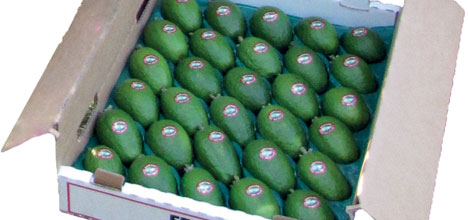
New Zealand feijoa growers are trying to crack the Singapore market with Whakatane growers Rob and Mary Jessop providing one third of the first 150 trays sent there.
They were sent to boutique-style shops, where free sampling was set up for people to try the fruit.
An Australian buyer, based in Singapore, approached the growers to sample feijoas on the Asian market.
The versatility of the feijoa is going to push demand up and expand other export market potential for the unique fruit says Rob.
There are currently about 200 feijoa growers in New Zealand producing between 500 and 1000 tonnes annually, with 400-500 tonnes going to pulp.
There are five main growers who export from New Zealand who collectively export 25-50 tonnes of feijoas – 80 per cent of exports go to Australia.
'We feel the market for feijoas is just starting to come into its own,” says Rob.
'We think it's going to surpass the kiwifruit.
'The antioxidents are really high and you can do so much with them.
'The export market is starting to grow again; for every carton we have sent there is sale for it – the demand is there.”
New Zealand Feijoa Growers Association president Tim Harper says they are promoting feijoas in the United States and Australia, which are the two main export markets. Exports are limited because of air freight prices as the fruit would spoil if it was shipped.
'Growing the export market is the main thing we are working on at the moment,” says Tim.
'We are working on marketing strategies, flyers, in-store tasting.”
Tim says New Zealanders don't know how lucky they are.
Feijoas are only grown in abundance in New Zealand and South America, with Brazil being the main export competitor to New Zealand.
Because of the limitations elsewhere, other countries have to be shown and taught how to eat the fruit.
'The populations haven't got a taste for them,” says Tim.
'We have to teach people to scoop and eat them – that's the first thing.”
Then it's teaching them all the things you can do with the fruit, although Tim says they are working on educating New Zealanders more too.
'They are as versatile as apples and bananas – they can be used in any dish bananas are used in.
'People use them to make wines, ciders, fruit juices, ice creams – there are a few really nice schnapps. There is even feijoa beer.”
Tim says he hopes the export market grows more and if their marketing works they are going to need growers.
'It's made a lot of people look a lot harder at feijoas.”
He says with suburban growth, New Zealanders don't tend to have the traditional feijoa tree in their backyard anymore.
'Traditionally a lot of people had their own feijoa tree – but housing and subdivisions have wiped out a lot of trees.
'You're going to have to pay for them now.”
Rob says if growers can market the fruit better overseas it will push the local price up.
He says the New Zealand market has probably reached its peak for the moment with prices for the growers without the export market growing further.
'Unfortunately the price is no different to what it was 10 years ago.
'We are probably like what the kiwifruit industry was 20 years ago.”
The price in New Zealand supermarkets varies between $6-10/kg.
Rob says it is uneconomical to take the fruit off their property for less than $1/kg.
The feijoa season lasts from mid-March through until the end of May in a good season, says Tim.
'A strong frost will make the fruit go brown early. Two months every year and that's all we get. There are no feijoas imported.
'Brazil, the only other country who does anything of volume, has the same season as us.
'A lot of people, I certainly did, underestimate how labour intensive it is – in pruning and picking. We have to pick for six weeks – not like kiwifruit, who harvest in two days.
'So that is more expensive, having to pay for that labour. That's why it's always reasonably pricy in supermarkets. It's the nature of the fruit.”

0 comments
Leave a Comment
You must be logged in to make a comment.