


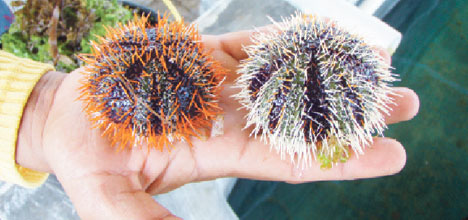
Sea urchins appear to be an ideal candidate for aquaculture.
They're so easy to breed that they're used as demonstration models in aquaculture training courses; they're omnivorous and therefore comparatively easy to feed and, most importantly, there's an established, lucrative and undersupplied market.
The tropical species Tripneustus gratilla is cultivated for reseeding in southern Japan, but its high value has led to population crashes in some parts of South East Asia.
Sea urchin roe is a traditional food in parts of Europe and Asia – particularly Japan – and through the spreading popularity of sushi, it's coming to the notice of gourmets in an increasing number of other countries, including the US and UK – check the internet for ‘sea urchin butter' to get an idea of the versatility.
The Japanese particularly esteem sea urchin roe – known as ‘uni' – so much so, that they consume about 75 per cent of world production. Top quality uni retails at up to NZ$550/kg and quality live urchins sell for about NZ$10-15 each. The market and distribution system in Japan is, however, complex and multi-layered – so the price to the producer would be less.
Demand
The Japanese have a large sea urchin fishery that's lucrative enough to attract the attention of the Russian mafia, but they still have to import 80-85 per cent of their needs. This level of demand brings familiar problems – much of the world's sea urchin stocks are over-fished and in decline. In South East Asia, the problem was so severe that the most valuable sea urchins almost vanished from some areas before remedial action was taken, but that's another story.
New Zealand kina is also in decline, but it's not commercial exploitation that's the problem here: Kina are much sought after kai moana and it's recreational fishing in accessible habitats, such as Mauao and Maketu, that has kept numbers down. In New Zealand, there is a small commercial fishery that services the domestic market, but their sporadic forays into the international market have had mixed results – primarily because of the flavour of the roe. Put bluntly – no one else likes it. The Japanese are said to eat with their eyes – a trend that is increasing in the West. Therefore appearance; colour – which should be a rich orange; texture; uniformity in size – 40-50mm is best; and a high glycogen level are very important. For various reasons, New Zealand kina does not measure up to these criteria.
This is where aquaculture plays a part. Sea urchins are being farmed successfully in many places in the world that have similar conditions to New Zealand – places such as the Norwegian fiords are full of them. In Scotland they are being farmed alongside salmon; keeping algal growth down, chewing through left over fish food and providing a much needed economic boost to Highland and Island economies. There is, therefore, no reason why New Zealand should not have kina farms – or at least fattening facilities where they are fed specific diets to improve their flavour and texture.
Cultivation
Dr Andrew Morgan from the Bay of Plenty Polytech has been working with sea urchins for years and says that different species of New Zealand urchins have different potentials for cultivation. In his opinion, the common one – Evichinus chloroticus – has limited potential, but a second, less common, species that lives in deeper water has great promise.
The market New Zealand producers should aim for is chilled nama uni; that's the grade used in sushi. It is high grade and high priced, but needs to be presented very well to be accepted. The rapidly increasing international popularity of sushi and the introduction of sushi dispensing machines is set to raise the demand for this product well beyond present supply capacity. It doesn't take a genius to realise that New Zealand's waters – extra nutrients and all – put us in a very good position, provided we're willing to put in a little bit of effort.
If the quality is not always up to sushi standard, then there's always ‘not-for-human consumption' products that can be almost as lucrative as uni, but are not subject to any of the health or presentation restrictions that apply to the food market.
The main one is kina roe as aquarium food; it's highly nutritious, highly valued and in high demand. At the lowest end of the scale, reject sea urchins and by-products can be sold as frozen burly – ‘burly bags' were successfully, but unofficially, tested by NIWA a few years ago and sea urchin burly is internationally regarded as one of the best fish attractants.
Then, with kina, there is always the alluring prospect of using them in pharmaceuticals and beauty products – both of which would be more valuable than the highest quality uni. The cultivation of kina is a challenge that, if met, will prove to be a lucrative business for New Zealand, but cultivation and processing into whatever form the market demands will not just generate income, it will provide much needed employment in our small coastal communities.

0 comments
Leave a Comment
You must be logged in to make a comment.