


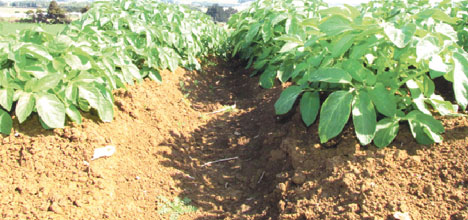
Monty Spencer is involved with two industries, which are currently afflicted by disease; he is managing the constant threat of psyllid to potatoes – while spraying his Katikati kiwifruit orchard prolifically in the hope of protecting it against Psa.
Monty is the research and innovation manger for AS Wilcox & Sons Ltd, based in Pukekohe – overseeing the growing of the company's potatoes, carrots and onions.
He and his wife are also the private owners of two small Gold kiwifruit orchards in Katikati and Ardmore.
Psyllid is considered the greatest threat to the New Zealand potato industry, while Psa is pulling a depressing cloud over the kiwifruit industry.
'It is a depressing situation – there is no doubt about that.
'The problem is that the control measures that are currently available are probably, at best, about 10 per cent effective in trying to halt the spread of Psa. So it's not good news.”
On the other hand, in the battle against psyllid, Monty says he can see the 'light at the end of the tunnel”.
'With psyllid, we have control methods and they work fairly well. From that point of view it's not so bad.
'At least we're basically being able to have some control over it compared with the Psa in the kiwifruit.”
That control, however, comes from a carefully designed spray programme, which has driven the cost of a healthy yield skywards.
Monty says they first got psyllid in their potatoes three years ago and fought back with a tight insecticide programme.
At the same time Potatoes NZ, the potato growers national organisation, mobilised a very intensive multifaceted research and development programme, 'which has produced some very successful outcomes during that time, which we have been able to incorporate into our approach in fighting the psyllid,” says Monty.
'When we first got it, and we were doing 20-odd sprays, we could be spending $1200/ha for a season.
'Before it came in we would have been pushing to spend $100 or $200/ha on insecticides.”
The 20-plus sprays were not sustainable, however, says Monty.
'Last season we came back from the very intensive weekly spray programme, to one that had applications with wider intervals.
'To enable us to have confidence in this approach each of our paddocks was scouted weekly for psyllid incidence in the foliage and applications were made on a more ‘as required' basis.
'Now we could be spending probably $500 to $700/ha.”
Monty says the costs have only flowed on 'a bit” to consumers, 'but because it is so competitive – the returns haven't gone up commiserate with the costs.”
AS Wilcox & Sons grow potatoes in three main areas; Pukekohe, Matamata and Ohakune, while also growing some north of Kaitaia and also in Rakaia.
It grows potatoes for fresh markets and for processing – crisping and French fries.
'What happens with the psyllid is you get lower yield, the drymatter gets lower (they get more watery), this is a particular problem in the processing industry as they require high dry matter (floury) potatoes and the third thing that can happen is you get ‘ZC' – a zebra chip.
The crisp upon frying looks like it's got a zebra pattern.”
This damage is a considerable problem in causing down-grading in the processing industry in particular.
Psyllid carries a bacteria-like organism – Liberibacter (this is actually the organism causing the ZC) – the psyllid injects the liberibacter into the plant, it gets transported throughout the plant and down into the tubers.
The leaves turn red/yellow and roll up and the plant dies.
'But this is for all the solanaceae family (the nightshades),” says Monty.
'Tomatoes, capsicum, tree tomatoes, all of these get attacked by psyllids. So they're all having to deal with the psyllid.
'The tree tomato guys are getting trees knocked out.
'In the glass house, control can be achieved more easily, because you've got more of a controlled environment than you get outside.”
Monty says the potato industry is monitoring psyllids using sticky traps, but they are 'not often highly correlated of what's actually in the crop itself, so it's a real rough indication” to ascertain numbers more accurately.
'So we do counts of psyllid in the crops, from that we can ascertain our spray interval. So if, for instance, it's a period where they are building up rapidly, then we can put on a spray ahead of when we would normally.”
There can be three to four generations of psyllid during the summer and how quickly those build up is very dependent on weather conditions. Rainfall has a big effect – 'if you get a big dumping of rain it knocks the psyllid numbers back quite a lot”, says Monty.
'But in general, there is some evidence that comparatively few psyllids can do a lot of damage to yield and dry matter.”
In general, the spray programme is about one spray every two-three weeks, says Monty.
'Last year we would probably have averaged 10 or 12 sprays and achieved good control; we use a range of sprays because if you use one spray all the time resistance can develop.”
The insecticides now found to be the most effective 'are a lot safer to humans and the environment” and don't knock out the predators to psyllid, but come at a considerably higher cost because they have only recently been developed.
'Previously, when we applied 20odd sprays a season, we achieved very good psyllid control, but it was not sustainable.
'That's when we decided we needed to be a bit smarter. We also had a lot more knowledge because of all the research that the Potatoes NZ had been undertaking plus our own.
'We now had chemicals registered for psyllid control – when psyllids first arrived in New Zealand there were no materials registered for psyllid control – we now also have some idea about the merits of each material and therefore target its application strategically.
'When I look back over the last three years and the progress that has been made, principally by the industry R&D programme and its associated extension programme, but also by growers being able to integrate the results from this programme into their own situation on farm – progress has been rapid.”
Monty says there are potentially plenty more solutions in the pipeline, with ongoing research into breeding resistant/tolerant varieties, researching even softer materials than currently available, the introduction of more specific predators and many other initiatives. 'It has also tended to make the potato industry more cohesive.
'I hope we can get the same sort of outcomes out of the programme that Zespri, KVH and the kiwifruit growers have got in train at the moment to try and control Psa.
'Although the psyllid problem looked monumental for the potato industry when psyllids where first detected in New Zealand, it tends to pale when compared with the Psa challenge in the kiwifruit industry.”

1 comment
Monty Psyllid
Posted on 27-02-2012 16:06 | By Warehi Britton
Poor old Monty is very difficult to follow. What for example does:'not often highly correlated of what's actually in the crop itself, so it's a real rough indication” or even worse:'but because it is so competitive - the returns haven't gone up commiserate with the costs.” Never mind I am sure he means well and is a nice bloke.
Leave a Comment
You must be logged in to make a comment.