


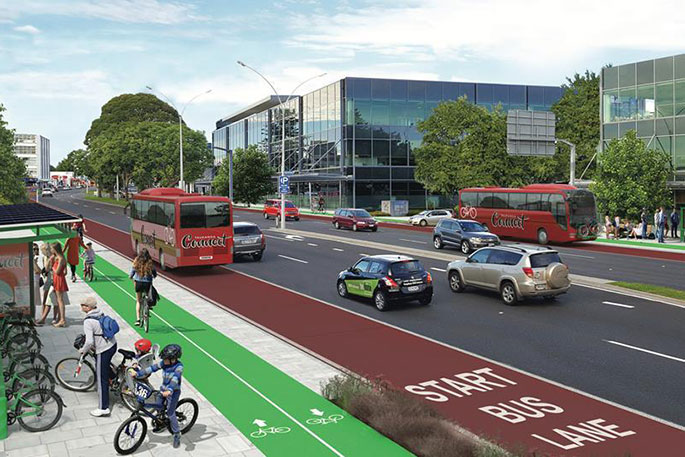
The Tauranga Transport Alignment Project's recommendation for the council to think big on transport funding is unlikely to affect the current LTP transport issues because of timing, say city council staff.
The TTAP is recommending the city council speed up investments in transport infrastructure from the current 30 year timeframe, so that all key projects will be implemented within the next decade.
The city council and others in the region are being asked to support a bolder plan for public transport, incorporating rapid transit infrastructure and bus priority measures, as well as protecting rail corridors and investigating passenger rail.
The TTAP would leverage off the funding increases recently announced by central government for cycling, public transport and rapid transit.
'This is a golden opportunity, as Tauranga is the only city in NZ that can tap into rapid transit funding over the next six years as well as the Provincial Growth Fund,” says spokesperson Glen Crowther from Sustainable Business Network.
The Provincial Growth Fund can be used to top-up the local share for transport projects in regions such as the Bay of Plenty, and to speed up projects that are strategically important. All funding requests to central government need to get into the Regional Land Transport Plan, which must be signed off by Bay of Plenty councils before the end of June.
'We are pushing for projects that offer people better and safer transport options, ensure efficient movement of freight, and help to reduce transport emissions. Public transport infrastructure is a great fit, as a good public transport system will meet all those goals,” says Glen.
Councillors deliberating on the Long Term Plan today following recent submissions, are facing more conservative recommendations on transport from council staff.
While 856 submitters want the city cycle plan implemented quicker than the proposed 30 year time table, the recommendation is council take about three years to look at the situation before acting on the cycling portion of the transport network.
This time will be spent undertaking option analysis, value engineering, investigations and community engagement to provide more certainty of costs and programme going forward.
It is similar to the approach adopted for the stormwater level of service, where Council invested in planning, modelling and costing which then enabled a programme of capital works to be committed to in a subsequent LTP. But some more straightforward options can be started earlier.
Principal Strategic Advisor Mathew Stewart advises councillors that the actual timeframes will probably take longer than advised in the draft cycle plan.
He says the timing of the Government Policy Statement means it will not be fully adopted in time to inform Councils' Long Term Plan processes. The NZTA has indicated that increased Funding Assistance Rates could become available for priority activities such as active transport, public transport and road safety. But NZTA decisions will net be made before June 2018.
'If increased funding assistance rates were available the expectation from NZTA would be for this to accelerate programmes, rather than to maintain proposed programmes and reduce local share,” says Mathew.
One option open to TCC would be to increase the overall spend in these areas while maintaining the same TCC contribution. This approach was used in accessing the urban cycleways fund through the 2015-25 LTP.
The other option is to allocate additional local share to leverage additional funding over the three year term for which it would be available. This is the approach taken to the increased FAR for LED street lighting, where funding was brought forward to make the most of the opportunity.
The Tauranga transport Alliance says on a per capita basis and taking into account government transport policy, the city should be seriously considering a $1 billion spend over the next six years.
The Government's land transport policy statement is stating $3.82 billion will be spent on public transport across the country over the next six years.
While the Bay of Plenty Regional Land Transport Plan is looking at a spending $12 million on buses over the next six years, plus operational costs; the alliance says there is actually a minimum of $190 million available over the next six years – excluding any rapid transit funding.
That is based on the Western Bay of plenty being five per cent of the New Zealand population with a bus network.
Nothing is set aside in the regional plan for rapid transit funding, yet there is a minimum of $220 million available over the next six years.
Similarly with Walking and Cycling Funding.
The government policy statement has up to $715 million available across the country over next six years, with up to $60 million available to be spent on Tauranga cycleways. It's nearly twice the $32 million the regional land transport plan has allocated to spend on Tauranga cycleways over the next six years.
Potential increased budget availability due to a higher NZTA subsidy for cycling projects with individual budgets in the LTP have not been taken into account in the bulk budget estimates to implement the Cycle Plan, says Mathew Stewart.
'This is because the exact costs of projects with individual budgets will not be known until construction is complete,” says Mathew. 'Also the NZTA revised subsidy rate is still unknown. As such it would be unwise to factor any potential available budget into the bulk Cycle Plan funding.”
The TTAP is a working group representing 20 organisations.
Moving to a multi-modal transport system is essential, says Bay of Plenty Medical Officer of Health Phil Shoemack.
'We would save 50 lives a year in Tauranga alone if it had the same mode share as Wellington,” says Phil.
'That means doubling the number of people in the city who walk, bike or bus. If you add in the wider health benefits, it makes a compelling reason to significantly increase investments into safer cycleways and public transport.”
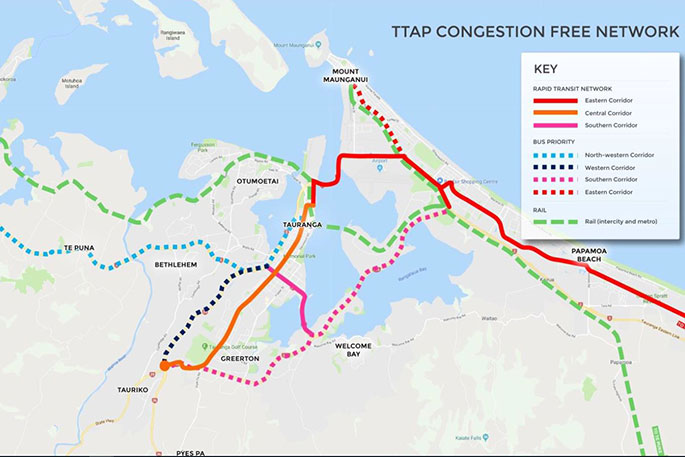
The core of the TTAP proposal is a congestion free transport network which will make it faster and cheaper to get around the city by public transport, says Greater Tauranga spokesperson Heidi Hughes. The goal is for travel by public transport between central Tauranga, Greerton, Hairini, Poike, Mount, Arataki, Papamoa and Omokoroa to be cheaper and faster than by car at peak times.
'If that is to happen, it will require a massive increase in public transport funding. We currently spend about 1/9 of what Wellingtonians spend on their public transport system, so we are proposing big increases for the existing bus network and for bus rapid transit,” says Heidi.
The TTAP focuses on a 5 Point Action Plan:
Develop a 'Congestion Free” Public Transport Network based along these corridors:
Central Corridor - Cameron Road from CBD to Barkes Corner
Eastern Corridor - CBD to Papamoa / Te Tumu
Southern Corridor – 15th Ave/Turret Rd from Cameron Road to Hairini and along SH 29A
North-western Corridor - along SH 2 from CBD to Omokoroa
Western Corridor – CBD to Tauriko
Implement Bus Rapid Transit and bus priority measures, as well as rideshare facilities. Develop business case for commuter ferries - CBD, Mount, Omokoroa and islands.
Protect corridors for future rail or light rail and investigate passenger rail opportunities. Buses every 20 minutes throughout city, every 10 minutes on key routes at peak times.
Free Buses for school-age children on all Bay Hopper and School Hopper buses. Complete the Tauranga City Cycleways network within a decade – focus on schools.
Address key congestion points in the roading network based on a multi-modal approach. Comprehensive Demand Management programme, incorporating rideshare apps and MaaS.
Chamber of Commerce CEO Stan Gregec says the rationale for the TTAP is sound.
'The Western Bay of Plenty is a strategically significant location and the port, state highways and arterial routes around Tauranga are a nationally important transport hub,” says Stan.
'With massive growth predicted for the kiwifruit and forestry sectors and 40,000 new dwellings proposed for Tauranga over the next 30 years, there is an urgent need for a safer, more efficient, and more resilient transport network.”
Organisations Endorsing the TTAP:
BOP Community Trails Trust
Bike Mount
Bike Now BOP
BOP District Health Board
Envirohub BOP
Greater Tauranga
Ngai Tamarawaho and Ngati te Wai
Ngai Te Rangi iwi
Ngati Pukenga iwi
SUPA-NZ
Sustainable Business Network
Tauranga Chamber of Commerce
Tauranga Connect
Te Puke EDG
Toi Ohomai Institute of Technology
Tourism Bay of Plenty
More organisations have joined since the proposal was filed.

3 comments
IInteresting group of organisations endorsing the TTAP.
Posted on 29-05-2018 12:20 | By Duncanban
While I don't know who some of the organisations said to be endorsing the TTAP, I do recognise that a number are involved with cycling and walking. However I don't see any specific car users association being asked for their input. Surely the AA would be an interested party?
Think big! Pfft
Posted on 29-05-2018 14:33 | By maildrop
Just look at all that wasted space on the very expensive drawing. Bus lanes and cycle lanes galore. Nice little shrubs taking up valuable real estate. All for nothing.
SORRY, but did I miss something??
Posted on 29-05-2018 23:57 | By The Caveman
Great picture of the propose NEW Cameron Road. TWO traffic lanes each way - great ! Just like today. BUT WHERE HAS THE SPACE for a BUS lane and a CYCLE lane on BOTH sides on the road suddenly appeared from ????? AGAIN, we the public are being TOTALLY lied too by the Council with their fancy pictures. There is NOWHERE on Cameron Road that the current TWO traffic lanes can be retained, with a BUS LANE ADDED and with the shown cycle lanes as well
Leave a Comment
You must be logged in to make a comment.