


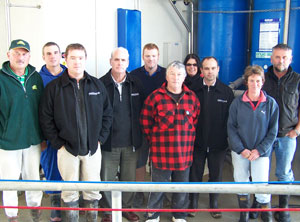
Back in 1984 Marcelle and Murray Douglas purchased a small chunk of land from his parents Bruce and Barbara Douglas.
| Back to Front, left to right: Gavin Cooper, Roger Douglas, Gary Brown, Martin Duff, Carol Kake, Blair Hoag, Murray Douglas, Paul Gilling, Kevin Trumper, Marcelle Douglas. |
Consisting of 120 hectares, this was the beginning of the rapidly growing dairy farm. The dairy farm has now expanded to 600 hectares. Of that, 200 hectares of this is in native bush and forest, the remaining 400 effective hectares is used for the dairying operation. Murray also has a 40-hectare runoff in the local vicinity, which he uses to graze the replacements.
The original cowshed on the farm purchased from Murray's parents was a 30-aside herringbone. With one or two modifications. This is still in use today.
It once milked about 450 cows, but will now drop back to 300 with the new shed in operation. Murray's wife Marcelle manages the smaller block, and will keep running that as a separate unit. After the first year breaking in the new dairy shed Murray intends 'growing” some people into the role of milking, so that he can step back and supervise the whole operation.
Murray, with some input from his three sons, Ian, Tim and Rodger decided it was well and truly time to build a new dairy shed. Murray was keen to put in a Waikato Milking Systems 54 bail rotary. The decision to use Waikato Milking Systems was an easy one on Murray's part, primarily because of the local service provided by Northland Farm Services.
'I had worked with the team for quite some time, plus they had the technology we were wanting”, says Murray. His sons all had a hand in the decision making for the new shed, not only that but they were also on hand at various times to assist with the preparation and groundwork.
All three sons had been overseas, with Ian coming home just after Christmas to help. Tim is currently a pilot in Africa who does surveying, and he helps out when he comes back home. Rodger has been on a years exchange in Brazil, studying Tropical Agriculture at a University in Sao Paulo, and has recently returned home, and will head back to Massey to complete his degrees.
As I was driving down the road, I spotted the Douglas' new shed from quite a distance back. It was a vision of beauty in the already spectacular countryside.
The calvers were coming in from the Herd Homes and up to the platform so they could get the feel for the new shed prior to calving. This way they are semi used to coming towards the platform. Murray says 'By doing this the cows will naturally want to come into this corner of the yard when they start milking”. This is done for 10 days prior to milking. Murray and his team of contractors all worked very closely together, and as the outsider, I could quite clearly see that they all had a very good working relationship.
Murray started with a big picture, and it was important to get levels right.
Murray visited plenty of dairy sheds in his quest to build the shed that was right for his needs.
'When I visited these other sheds, they had done this and done that, but they hadn't looked at the bigger picture, so that would be my biggest encouragement to people when creating something like this, to take the time to think about where they want the site to be over time, not just the dairy itself.
'The challenge at the moment is to evolve new systems, and it means I have to take the staff with me when I do that, and evolve systems with people and animals in mind.”
Over a year ago son Rodger came back from Australia. Murray says 'One of his comments to me was, 'Dad, you need to make the easy thing, the right thing, and it sounds pretty simple, but we've had that concept in the process of the development, because when you're employing a bunch of people to run an operation, you want the right thing done, so you've got to try and make it easy for that to happen.”
Site preparation began in October November 2007, with Aaran Pascoe Contracting doing the bulk of the work. Aaran has been at the farm doing something most months. To date he has a long list of completed jobs, starting with the site prep for the two herd homes that were constructed prior to the new cowshed. Aaron has also done the feed pads, race work and effluent ponds. All, might I add, assisted by Murray and his sons, who helped with the initial setup and levelling, plus set up the concrete work for the herd homes, and got it all ready for Clays concrete to come and place it all.
Aaran stated that what he started with was pretty much all paddock. Starting with stripping the topsoil right through to putting a two and a half metre fill under the cowshed site. A huge amount of fill was brought in for this, plus for the fill under the Herd Homes. Aaran also did the earthworks for the enormous silage pit.
Aaran started the shed site so it was ready for Barfoote Construction to get their part of the project underway. All the contractors happily worked in around one another.
Taking a walk around the back of the shed, and saying a wee prayer for purchasing new gummies, we went to check out the effluent ponds. Very impressive to say the least! There were three huge ponds that I could see, all with their own jetty. The jetty going out into the pond is in case something gets blocked, thus allowing a person to get out there safely and unblock it easily.
'We have a lot of effluent ponds”, says Murray, 'The emphasis is to keep the clean water out of the effluent system”.
Aaran used a big 20 tonne digger for the ponds and because they had to work to levels a lot of the dirt had to be carted away to waste. This was used as fill in hollows over the farm.
The effluent ponds have been setup to allow for 120 days' storage. The aim is that the farm will go into winter with the ponds relatively empty. There is a four-pond system in place, with a wetland discharge.
A regional council consent to discharge into waterways, will only be used at times when the paddocks are saturated.
Because the Douglases have a very large storage capacity for their effluent, so the need to use waterways is very rare. During the drier weather the effluent is spread on the pasture.
Aaran spent such a long time on the Douglas's farm, that one night when Murray went to a meeting he was approached by a neighbour wanting to know when he was going to let Aaran go as he needed some work done on his own farm.
Born and bred in the area, Aaran went to school with Murray's sons,
and does a lot of rural work in the area. Eighty percent of Aaran's work is rural based.
Barfoote Construction was employed to construct the dairy shed building. 'We primarily contracted Barfootes for the job because of a couple of key people, one of them being Matthew Sidford, who was the major deciding factor, he is just so good. Barfootes had the ability to do the whole job, and we knew we would get a good job done.
'Barfoote Construction has some very capable people working for them,” says Murray.
Trevor Barfoote was present on the day I was there. Trevor is the General Manager and Director of Barfoote Construction.
Trevor explained to me that they first of all need a client to build a building such as the Douglas one. 'Murray and his family came to us with the concept of what they wanted, and we devised the finer details of the concept to what we see here today”. Said Trevor 'It is very much a team effort to arrive at something like this” 'With the Northland terrain we tend to devise the shed around the site requirements of the owner”.
Barfoote Construction does a vast array of shapes and designs, and they really are most impressive buildings to look at. Although this was a flat area to begin with, a lot of fill was still required, with design having to be done around site constraints.
The shed design goes right down to the end of the yard. Precast beams join in the centre of the shed to hold the building in place, with each buttress having two piles under them, each beam weighs 7 tonne.
The Douglas shed has sides on it, due to the fact that the shed is more exposed to the cold South Westerly winds.
The design of the Barfoote Construction sheds allows good air flow through the sheds, plus as Trevor says 'When people are spending this much money they want something they can be proud of, and the cost difference for the standard timber frame shed is not that much different.”
Matthew Sidford from Barfootes gave a huge amount of attention to detail and making sure of the levels and details to ensure the right outcome.
Trevor says, 'Projects like this don't just happen, they are created by the people that care.”
Matthew and Murray worked together everyday. Murray saw all the contractors every day.
They got together every morning and talked about what they wanted to achieve that day, and if contractors needed any help then Murray and his team were right on hand to assist.
Kevin Trumper Electrical did all the electrical work. 'Kevin works in really well with Garry from Northland Farm Services, and he has an amazing knowledge of what's required”, says Murray. 'Kevin is an amazing man, he did jobs for us ten years ago, and still remembers all the details about each job.”
'Kevin has been working for me for quite a few years, so it was absolutely no question when it came to deciding on the electrician for this job.”
Under the concrete of this shed there is about 600 metres of conduit going into the switchboard. There is a lot of labour-intensive work even prior to the concreting for the electrician.
There is also cable going down into the Herd Homes. Kevin has been in the area for 22 years, and has worked for Murray for 20 of those years. Kevin says, 'We know how each other works. I know what Murray expects and a big advantage is that I haven't had any constraints put on what I'm doing, Murray just says 'Do It”.
Active Refrigeration from Whangarei installed the refrigeration system.
'The refrigeration system for the shed has plenty of capacity if Murray wants to upgrade at a later date”. Says Martin Duff from Active Refrigeration.
The heat exchanger unit keeps the water at a steady temperature of 35C.
Instead of heating water from 18-20C it's already at 35C. This aids in power saving also.
'People are looking into Power saving more often now,” says Martin. 'They want to install more efficient systems. There is a lot of heat saving with electricity. The refrigeration units concentrate on the vats, that's their job.”
For farms that have water-cooling problems, Active Refrigeration can also do a chilled water option as well, where you can chill your water to 12C
And that goes through the plate heat exchanger so milk will hit the vat at 13C.
Murray has two Herd Homes erected just opposite the race at the bottom of the yard.
The Herd Homes are constructed with a 1.2 metre deep concrete bunker. With segments of concrete slats placed over the top of the bunker, made of 6” reinforced concrete to handle the weight of machinery when cleaning out.
The slats are all made of highly stressed reinforced concrete with a slight bow in it which I could feel underfoot as I was walking through it. This is to allow for some spring in the concrete to prevent cows from getting sore hips. There is a central wall that runs through the middle of the bunker, giving essentially two bunkers each with sets of grates. The wooden pole system is erected on top of all that.
Another feature of the Herd Homes is that even with open sides it is still warm. The idea of that is that there are little side roofs, which are not there just to protect the feed from getting wet, but to push the air flow through the gap at the top. Air coming through pushes hot air down to where the cows are, so you do not get ammonia smells building up.
Murray has made his own addition to the Herd Home, with concrete bins right along both sides of each shelter for the feeding of maize silage. Murray says that this reduces a huge amount of wastage. 'Making the right thing the easy thing”. Is a phrase Murray says often.
..continued
David Taylor from LIC was subcontracted to install the Protrack drafting system. I had quite a few LIC reps on hand to greet me when I arrived at the Douglas's shed.
Paul Gilling took me around the entire Protrack system so that I managed to get a good understanding of how it operated.
The Protrack system means that farm staff can view any animal's details at anytime, even from the house.
This system enables each cow to be duly recorded from the time it enters the bail. A scanner will pick up the ID tag, and the acubail unit picks up the bail number and marries the cow up with the bail she is in. If a cow with mastitis or colostrum comes on to the bail the computer will alert the milker, as soon as she enters her bail.
There is a three way drafting system which can be set up in advance so that if there is a selection of cows that need to go off to the works, this can be setup into the computer ahead of time including the date of pickup, and on that day the cows will automatically be drafted into the correct pen so that they can go on the truck. There is no room for worker error this way.
Paul says 'The Protrack system dramatically reduces cost to both farmer and ourselves, as we can setup and use the PC in the background from our own office if there are any problems”.
Full training and ongoing support are given and included in the cost of the system purchased, as is upgrading the software.
LIC have group training days, where farmers get together and talk about what they do with the system, and share all their own ideas.
Any event at all can be recorded on the Protrack system. This means Murray can manage his herd from the shed while he's milking.
Later after milking is completed and details have been updated, all the information is then synchronized and sent straight through to MINDA.
Paul says 'What we are finding, is that farmers are learning more and more uses for Protrack. We find that people buy it for one reason, such as mating, but the more they use it, the more uses they find for it. Learning to use it is pretty straight forward”.
Protrack can be purchased according to budget, and then the farmer is able to work their way up the modules.
Bruce Cameron did the painting of the shed walls from Acraflex.
The rectangular yard is fitted with a Reporoa Engineering backing gate, and a Technipharm cattle handler. Murray milks predominantly Friesian with some Friesian cross cows.
In 2007 season 25 cows were lost due to flooding of the farm.
When the shed was up and operational the cows only needed to be chased on for the first few days, now it's not a problem at all, and the backing gate does not even need to be used. Considering the cows have come from a herringbone they have settled down really well.
When I visited Murray and Marcelle's new shed it had been operational for only 12 days, was spotlessly clean and I know it will stay that way too.
Murray says, 'There was a big concern around the environmental effect on how we actually manage this system here to be sustainable long term. So a whole lot of those things have come together in this project. One of the best things about this project I've managed is that way that all the people I've had involved, have come on site and brought into what we've been trying to create.
'It has been really stressful, but really quite neat in the way they've all come together and delivered. It's been fantastic.”

0 comments
Leave a Comment
You must be logged in to make a comment.