


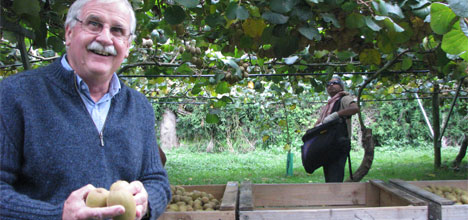
This season's kiwifruit harvest is bitter sweet for Pyes Pa orchardist Dave Goodwin.
Sweet because his organically grown new Zespri variety G3 produced a good sized crop of well formed, sweet tasting fruit - and bitter because just up the road the Psa-V disease has spelt the end of Hort16A gold vines on his other orchard.
Organic kiwifruit grower Dave Goodwin is very happy with the volume and quality of the new variety G3 produced on his Pyes Pa orchard this season.
'I'm very pleased at how this G3 crop has turned out and while we've had some frights, so far there have been no positive tests results for Psa-V in this orchard.”
G3, a new gold fruit developed by Plant and Food and Zespri, is the industry's short term saviour in the battle to recover from the devastating bacterial disease Psa-V. Dave is among the first growers to take part in pre-commercial trials of the fruit, before Psa-V was discovered in New Zealand in 2010.
"Thank goodness we had this fruit and the other new varieties which appear to be more tolerant of Psa-V.”
The first G3 vines were grafted in Dave's orchard in 2008 and a second block in 2010. Both produced well this season with the fruit reaching maturity in a condition, which should ensure consumers enjoy a sweet eating experience.
For the first time Zespri has enough organically grown G3 to test market it as a separate category, something which pleases Dave because previously organic volumes were so small, the fruit was sold alongside conventionally grown fruit.
Zespri will export more than one million trays of both conventional and organic G3 fruit this season and has 450ha in production and that is expected to rise dramatically when more vines are grafted this winter.
The size and volume of fruit achieved using organic growing techniques has impressed Dave because traditionally organic orchards produce smaller and lower volumes of fruit.
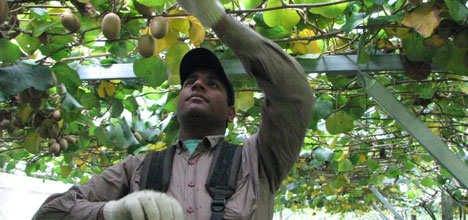
Rajveer Singh harvests the new gold Zespri kiwifruit G3 on the organic orchard in Pyes Pa owned by Dave Goodwin.
He's planning to graft G3 onto root stock in his Hort16A orchard, where the vines are no longer producing fruit and have been removed.
'We've done what we can with very careful hygiene protocols to try to prevent spreading infection from the Hort16A orchard to this one and to date it seems to be working.
'I'm confident we will learn to manage Psa-V but there's no silver bullet. It will be a combination of more tolerant varieties, management and sprays.”
Dave and his team kept the organic orchard disease free, even though, because of the orchard's organic status, they have less spray options available than conventional growers.
Many growers, particularly those in Te Puke, who have removed vines, are now considering the options of grafting to G3 or G14, the sweet green kiwifruit, to replace their Hort16A Psa-V infected vines. The success of orchardists like Dave, who have grown the new varieties for up to four years, are being closely watched by those deciding where their futures might lay.
Zespri will announce this month the start of the tender process for new variety licences. It is expected many orchardists who have cut out Hort16A vines will graft to G3 which has so far shown a good level of tolerance to the bacterial disease and been well tested in the markets.
It is hoped growers can return to a level of production within two years and the Bay of Plenty and the New Zealand economy need that to happen because the kiwifruit industry accounts for about 25 per cent of the Bay's gross domestic product (GDP).
Nationally, Zespri has been a $5 billion business contributing $2 billion to New Zealand's GDP. The kiwifruit industry directly or indirectly employs at least 26,300 people but some estimates put that figure closer to 45,000.
Despite the ravages of Psa-V which has infected 1169 orchards, the majority of them in Te Puke, Zespri expects to export around 90 million trays this season. While down on last year's record 105 million trays, the decrease is not all due to Psa-V but also to a normal seasonal variation which sees vines produce slightly fewer fruit in the year following a bumper harvest.

0 comments
Leave a Comment
You must be logged in to make a comment.