


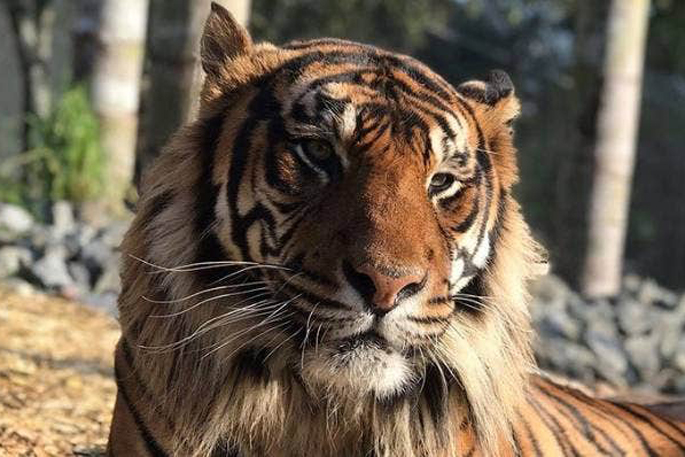
A tiger has died in Hamilton leaving a valuable legacy for the city council, that a predator's instincts can expose fatal flaws in zoo safety procedures.
Hamilton Zoo's notorious Sumatran tiger, Oz, died on Wednesday after suffering from serious renal complications.
The 15-year-old tiger had been a part of the Hamilton Zoo's pride since 2013, but the animal made headlines in 2015 when he mauled senior zookeeper Samantha Lynda Kudeweh, 43, to death.
While Oz's death has brought back painful memories for many, Hamilton City Council CEO Richard Briggs says the incident has taught staff and council 'you can't be complacent” with wild animals.
On September 20, 2015, Kudeweh was killed not long after she had fed Oz, who was in the main tiger den at 9am.
After placing the tigers' meat in the "feed flap" in the den of an area called the "Old Tiger House", she left, but did not close any of the gates between the outside enclosure and the den, allowing Oz to continue to be able to move freely between the two areas.
Kudeweh returned to the tiger enclosure at 10am to get bamboo to feed the zoo's red pandas. It was at that point she was killed.
Her body was found in the main enclosure with Oz sitting next to it.
The incident sparked a Worksafe investigation and a court case.
Richard says the council stands by the statement that Kudeweh should have never died and takes full responsibility for not having in place the right levels of control.
While the zoo was working on a number of improvements at the time, her death highlighted that in high risk areas 'you need to go hard and fast” in putting those practices in place, he said.
'The unfortunate passing of Kudeweh highlighted that you just can't take your time with these things. You can't be complacent,” Richard says.
'There were a number of recommendations made that we have improved, but there was also a need for engineering controls which basically means that no matter whether someone is doing what they should do or not, everyone deserves the right to go home at the end of the day."
Since then, he says, they have implemented improvements, such as, interlocked gates, removing trees, putting in better security systems, and better fencing.
Independent experts also did a broader review of the zoo to make sure the other class one (dangerous) animals and other animals were safe themselves as well as the community and staff.
When asked if Briggs was confident an incident like this will never happen again, he told Stuff he believes everything that they have done at the zoo is best practice, but they are also aiming to improve.
'What it highlighted was that no matter how good you are you need to continue to be vigilant you need to stand up to make sure council is taking all their responsibilities appropriately in terms of keeping you safe as well.”
He says since Kudeweh's death more staff are also voicing their concerns to council when something isn't right or could put their safety at risk. This holds council to account for their own safety as well.
Briggs praised Kudeweh, a mother of two.
'She was an exceptional person and an exceptional leader and zoo curator and we should make sure that we honour her memory by continuing to be the best zoo we can be at Hamilton Zoo and all other zoos in the world to ensure a tragedy doesn't happen like this again.
'Sam Kudeweh was very well liked and popular because she was very good at her job and extremely good with the animals. It was a huge loss for a number of people in the organisation.”
On Wednesday both the Zoo and council farewelled Oz online, citing some of Oz's quirky behaviours and the important part he played in the international breeding scheme.
Zoo Director Dr Baird Fleming says 15-year-old Oz became unwell over the past week and tests on Monday indicated serious renal issues, a common complication in older tigers.
He says Oz was buried on-site at Hamilton Zoo in a special place reserved for all zoo animal whanau.
They made the choice not the mention Kudeweh's death in their online farewell to Oz, he says.
'Out of respect for Sam, her family and keepers past and present, we chose not to mention Oz's involvement due to the sensitivities involved. We made Sam's family aware of the news privately,” Dr Baird says.
He says the team were still feeling the loss deeply for both Oz and Kudeweh.
Oz was born in November 2004 at Tel Aviv Zoo in Israel and transferred to Auckland Zoo in 2006. An important part of the international breeding programme, Oz fathered Auckland Zoo's first Sumatran tiger cubs with Molek in 2008.
He transferred to Hamilton Zoo in 2013 where he joined Sali and fathered cubs Kirana and Kembali. Kirana remains at Hamilton Zoo with Sali and Mencari, while Kembali transferred to Adelaide Zoo in 2018 for breeding.
Sumatran tigers are critically endangered with less than 400 remaining in the wild on the Indonesian island of Sumatra. Numbers are declining due to habitat loss from palm-oil deforestation and poaching.

0 comments
Leave a Comment
You must be logged in to make a comment.