


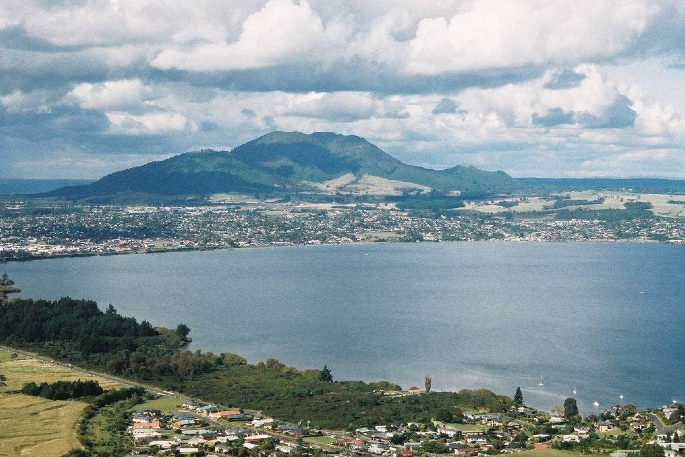
When Taupō supervolcano erupts, it'll be huge, right?
Wrong.
Scientists studying the shaky ground underneath Lake Taupō said since they increased the Volcanic Alert Level of the region from zero to one in September, they've been have been hearing that question a lot.
Spoiler – it's extremely unlikely to be a huge eruption, even if it did erupt.
According to GNS Science, the most likely scenario for the current activity at Lake Taupō would be that unrest continues for several months, dies down again, and the Volcanic Alert Level is lowered to zero.
'However, if volcanic unrest did increase over time, and the volcano was to have a small eruption (if we take a small, more common eruption from Taupō volcano) the volume could be about 0.1 cubic kilometres.
'Lakeside communities would need to evacuate as they could be impacted by thick ashfall and life-threatening hazards near the vent, such as hot ash flows and flying rocks.
'Ash blows with the wind, with thicker ashfall landing closer to the vent, so the areas affected will depend on the wind direction and strength,” the update states.
Assuming a westerly wind was blowing, the road on the eastern side of Lake Taupō, and State Highway 5 to Napier, would likely be closed due to ashfall.
The Napier and Hastings regions would also be impacted by ashfall and water supplies and electricity networks in the area would likely be disrupted.
Since a M5.7 quake shook locals awake on the night of November 30, scientists have recorded almost 700 aftershocks which are common during periods of unrest.
'Volcanic unrest involves magma and fluids moving beneath the volcano.
'This can result in earthquakes, ground movement, and gas/fluid release. Unrest can occur over years to decades and is very common globally – and is happening at Taupō volcano right now.”
GNS said caldera volcanoes like Taupō do not erupt without first experiencing volcanic unrest.
'While volcanic unrest means that an eruption is more likely, Taupō has had at least 18 episodes of unrest in the past 150 years, lasting for months to years, and none of them have led to an eruption.
'Based on this history, the current unrest period could continue for weeks to months, at varying intensities.
'The chance of an eruption occurring after only a few months of minor unrest is extremely low. ”
Looking back, scientists said the northern part of Lake Taupō was formed about 25,500 years ago during the exceptionally large Ōruanui eruption.
This was a 'super eruption” with over 1000 cubic kilometres of pumice and ash being rapidly ejected, causing a large area of land to collapse and forming the caldera basin, that is now filled with water.
A second caldera-forming eruption, the Taupō eruption, occurred about 1800 years ago in 232AD.
Although Taupō volcano is capable of caldera forming eruptions, such as the Ōruanui and Taupō eruptions, they are rare in the context of the past 25,000 years.
'There have been 28 eruptions at Taupō volcano, and all but two have been far smaller than those that everyone thinks of when they imagine a Taupō volcano eruption.”
There have been 15 small eruptions in the last 25,000 years at Taupō volcano – these are up to 0.1 cubic kilometres of magma erupted (1/10th the volume of Mt Ngauruhoe).
There have been 11 medium-sized eruptions in the last 25,000 years – these range from greater than 0.1 to 2 cubic kilometres of magma erupted.
The biggest of these were about three times the size of Mt Tarawera's eruption in 1886, which was 0.7 cubic km.
There have only been two eruptions bigger than two cubic kilometres in the last 25,000 years.
The most recent was the 232AD Taupō eruption 1800 years ago.
This eruption had an estimated volume of 35 cubic kilometres.
The second was the Waimihia eruption 3500 years ago, which was about 7.5 cubic kilometres in size – think a magma volume 7x bigger than the volume of Mt Ngauruhoe.

0 comments
Leave a Comment
You must be logged in to make a comment.