


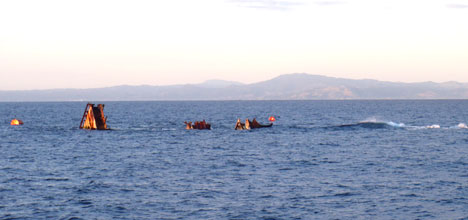
Compelling the Rena owners and insurers to remove the entire wreck from Astrolabe Reef remains the only way of extracting any monetary compensation for the grounding and aftermath, says Mount Maunganui businessman Nevan Lancaster.
Local businesses recently lost a court case where the Rena's owners Daina Shipping Company and insurers The Swedish Club successfully capped their liability to local businesses at $11.5 million.
New photos on April 11 show the Rena is almost completely below the waterline. Photos: Supplied.
'If you read his decision it's very much in favour of the Swedish Club over the small businesses in New Zealand,” says Nevan.
'He wouldn't even let us apply for information as to whether we would have any grounds for appeal.”
Nevan is leading a group of local businesses in a legal case to obtain compensation for loss of income due to the grounding of Rena in October 2011 and subsequent oil spill that impacting the coast across the wider Bay of Plenty.
Their legal advice that an appeal would be a waste of money, says Nevan.
'We are not sure what the total amount of the claims are, we are not sure if there are any others, any other claims that are going to be forced under that $11.5 million cap.
'And we are not sure if the Swedish Club themselves aren't going to make a claim under that cap – and force local businesses out even more.”
The Swedish Club could claim against the $11.5 million for its settlement with the Government, says Nevan.
'That's against what the government said was going to happen, but since they have walked away from the whole deal, we don't have much confidence in the good faith of The Swedish Club.”
The Rena owners and insurers say Nevan's claim that local businesses lost the court case is wrong.
Nevan was asking the court to determine whether further information should be provided by the owners/insurers to assist in his challenge to the application to establish a fund to settle claims.
The court ruled that Nevan already has sufficient information to decide whether to or not to challenge the application and noted that Nevan, whose claim is for $3000, is in fact the only party opposing the application to establish an $11.3million fund for legitimate claims to be paid from.
The Swedish Club's plan is to do as little as possible, until they get permission to leave the Rena aft section on the reef, says Nevan.
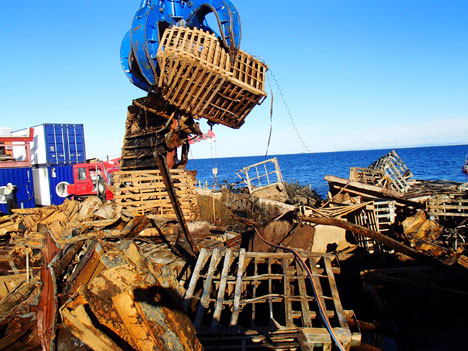
Debris cargo being removed from Hold 4 on April 8. Photo: Supplied.
'Now that Mr Lancaster has withdrawn his challenge, all affected businesses should in due course be able to lodge their claims in the High Court,” says a statement from NZ spokesman for the owners and insurers Hugo Shanahan at Sweeney Vesty.
'The owner and The Swedish Club have only been provided with details of a handful of claims, so they don't know how many legitimate claims exist, and for what amount. If the claims admitted by the High Court are within the $11.3 million fund, they can expect to be paid in full.”
The settlement with the NZ Governemtis outside the liability cap, says Hugo.
In a statement from the owners and insurers they say Nevan's argument that forcing the them to remove the wreck as the only way of ensuring an economic benefit to the local economy is simplistic and shows a limited understanding of the reality of international trade and insurance.
'In the first place, only a fraction of the costs will benefit the local economy – most will flow to the international salvage industry,” says Hugo Shanahan from Sweeny Vesty, the company handling media communications for the Rena owners and insurers.
'As always, insurance costs will eventually be passed back onto businesses and consumers. As a primary-industry based economy heavily reliant on trade to support economic growth, the local and national economy have more to lose than any likely short-term benefit. Mr Lancaster's suggestion may not represent the actual value he talks of when considering all the facts.”
Nevan says if The Swedish Club is forced to remove the entire wreck, it will bring another $300 million into the local economy.
'That's money coming from outside NZ, that's half as big as The Hobbit,” says Nevan.
'That type of business coming into the Bay of Plenty would be a huge boost.
'As far as I'm concerned the longer they have to work on that boat and the more money they have to spend on it the better for the local economy. We could use that $300 million boost.
'All those companies doing well out of it, I want them to keep doing well. I want the Swedish Club to spend three times as much as they have already spent on those businesses, with those companies, with those organisations.
'This is not a zero sum game. This is a win for New Zealand if we make them take the boat away. If we leave it there that's $300 million we won't ever get now.
'If we make them move it that's $300million dollars that will come into the Tauranga economy. I can't see that being a bad thing for Tauranga.”
Under New Zealand Marine law it was the Rena salvor Svitzer's responsibility to put together a plan to remove the wreck completely. Nevan says salvor Nick Sloane came up with that plan that would have had the boat gone by the end of the 2011 summer.
He claims the Swedish Club decided it was too expensive.
In the statement Hugo says the ship was stuck fast with significant damage below the waterline. The fully laden 37,000 tonne ship was travelling at 17 knots when it struck the reef. There wasn't time to remove it before it broke in January 2012.
'Soon after the grounding a range of scenarios were looked at to deal with the vessel, but they were all compromised by the extent of damage to the hull, and the vessel breaking in two in the early part of January, 2012,” says Hugo.
'Circumstances surrounding the Rena have been extraordinary, even by international standards. Salvaging the vessel was never going to be a quick and simple operation, definitely not one that could have been undertaken that summer.”
On the accusation of spending and doing as little as possible, the facts speak for themselves, says Hugo.
The owner and insurer have already spent $NZ300 million on ongoing wreck-recovery and environmental clean-up operations. Resolve Salvage & Fire is contracted to continue major clean-up operations in 2013.
Compensation of $27.6m has been paid to NZ Government, and a process is in place to establish an $11.3million New Zealand fund for business claims.
The reality is that the owner and insurer have consistently demonstrated a safe and responsible approach to dealing with the wreck.
The owner and insurer are undertaking a comprehensive set of assessments on the likely effects of leaving the remaining wreck. Once these are completed, a decision will be made whether to apply for a resource consent, says Hugo.
If consent is granted, resourcing will need to be put in place to avoid, remedy or mitigate any likely adverse effects.
'Full-wreck removal raises a number of issues, and is not necessarily the better option. With 18 months knowledge and experience of the conditions at the Astrolabe Reef – we know that there will be significant further effects to the reef environment. It should be noted that the wreck occupies less than one per cent of the surface area of the reef.
'As part of any resource consent application, the owner and insurer propose to establish a restoration package to provide a range of community based projects across the Bay of Plenty. This will provide benefits to the community which will not happen if they are required to remove the wreck,” says Hugo.
Resolve has removed 1006 tonnes of steel from the bow so far, and needs about another 20 near perfect working days to complete this work.
The final stages involves working right in or below the surf zone, which is why conditions have to be perfect to minimise potential risk to worker safety.
When conditions on the reef prevent Resolve working on the bow, they have been working to recover debris from the sea floor between the bow and stern sections.
So far, about 620 tonnes of debris, largely container based scrap metal has been removed.
The third and latest scope of work involves removing cargo and container debris in hold 4, and to try and locate and assess the current state of two containers of beads originally located in Bay 28.
Once located, the two containers will be assessed to determine whether the beads remain. If they are still in there, Resolve will develop a plan to remove them.

3 comments
FAIR PLAY PLEASE
Posted on 12-04-2013 15:07 | By KAMIKAZE
Any claims for business losses must have sound grounds and must be fully substantiated by financial accounts because try on's will only wreck NZ's credibility reputation.
Clarifications
Posted on 15-04-2013 09:31 | By Nevan
Nick Sloanes plan was submitted to Maritime NZ under section 248 of the Maritime transport Act. Then Svitzer was fired and the Resolve plan was instituted. I was not the only party applying for information. Local Iwi were as well and I am the chairman of the Business Action Group - Rena and the action was taken on behalf of 80 local business's and charities in our group. They have removed only 20% of the Rena in more than 18 months. Costa Concordia will be gone by September 100%. They could easily get more manpower and equipment to NZ to finish the job. They could have one barge working on the bow, another working on the stern and several picking up debris. Why only 1 barge and crane?
further Clarification
Posted on 15-04-2013 10:37 | By Nevan
6 months ago Hugo was telling us that the Local community was benefiting from the Rena Salvage now we are told all the benefits went offshore. Also the Govt spent $50mill on the clean up. Swedeish club have only paid $27mill. Also if he wishes to debate economics and global trade I will happily engage. My degree in Economics from the University of Waikato will match up to his in media studies or what ever degree he has to become a PR rep. Nevan Lancaster B.Soc.Sci (Economics) Uni of Waikato.
Leave a Comment
You must be logged in to make a comment.