


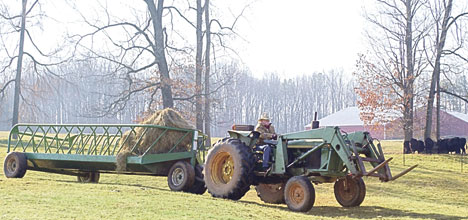
One person dies on a New Zealand farm every 18 days. Each day, 42 go onto Accident Compensation, and annually 25 farmers commit suicide – all of which illustrates most of this country's health and safety in employment policies aren't working, says D'Arcy Palmer, director of Farmers for Farm Safety Ltd, an independent on-farm advisory health and safety service company.
'The Health and Safety in Employment Act came into force in 1992 but in the 21 years since, there has been little improvement in fatality and serious harm incidents on farms. Too many people are still dying or suffering serious harm, all avoidable, and the approach has to change,” says D'Arcy who is a farmer without a farm, because of a farm accident.
ACC says unless safety on farms improves up to 20 agricultural workers a year will lose their lives in the workplace. That's one death every 18 days.
'I was in a hurry to get to a rugby coaching school for the New Zealand Rugby Union and rolled my vehicle. It took me seven years to learn to walk properly again.
I don't want to see that happen to anyone else which is why I began this business, promoting the first priority in farming which is to take all practicable steps to prevent farmers and farm employees from losing their career, lifestyle, family member, friend or financial security.”
D'Arcy spent two years gaining qualifications in Health and Safety and a further 12 months of his recovery researching and documenting everything he knew about on-farm hazards including man management and staff interaction.
Farm policy
He wrote a farm policy, which now forms the basis of a client commitment, and a comprehensive hazard register for all farm types, which also encompasses training.
'Every farm is different which is why I visit each farm personally to prepare a policy, talk to owners, employers and farm staff ensuring all contribute to the farms documented resource.
That service costs about the price of two truckloads of top soil. Not much really is it?”
Keeping his services affordable (his accountant says in fact too cheap) is D'Arcy's way of making sure all farmers can have in place a practical, efficient policy everyone understands which meet the requirements of the HSE Act 1992 and exceeds ACC audit standards. 'Lack of employer understanding and worker limitations do kill,” he says.
Under cover
To further his understanding of exactly what happens on a dairy farm, D'Arcy went 'under cover” as an employee and found out, far too personally, how dangerous that role can be.
'Within two months I was hit from behind, while stationary behind cows on a farm track, by a young worker on an ATV quad bike doing approximately 60 km/hr. I ended up in intensive care and at first wasn't expected to live.”
The farm employed a large staff and in 12 months there were five serious harm incidents: D'Arcy's injury, a PTO shaft incident, a female milker who lost a finger in the dairy, another worker who fractured his arm pregnancy-testing a cow which collapsed, and a young worker who suffered severe head injuries from an ATV incident. It was an experience which served to intensify D'Arcy's determination to do something positive to improve farm safety and stop the carnage.
Human cost
'I regard what I do now as a service which helps farmers implement policies to prevent injury and death on farm.
'Too often I see the impact of a farmer failing to take safety seriously, [written] on the faces of wives whose husbands are confined to wheelchairs, or the father who has accidently run over his child or the family of a young man who has taken his own life.”
All farm deaths and injuries are preventable, says D'Arcy, who believes suicides are a major but rarely-discussed statistic which warrants more publicity and advice on suicide awareness. 'If safety procedures around fire arms [that they should be kept in locked cabinets], were adhered to, fewer men would take their own life. When things get too much and a fire arm is handy in the ute, it's too easy to ‘act on impulse'.”
In D'Arcy's 38 years of farm ownership, nine farm owners and three young people died in his district, two from suicide and the others from a varied mix of machinery accidents, but not one involving an ATV.
The farm environment is a dangerous place with a whole host of hazards waiting to injure or kill the un-wary – and no amount of ACC pamphlets or safety manuals will make a difference unless everyone who lives and works on the farm understands task safe operating procedures and buys into safety implementation, says Darcy.
'A large percentage of farm workers, owners and managers are dyslexic – 20 per cent of my clients or clients' staff either cannot read written instructions or find them difficult to read.
'They are kinaesthetic or tactile learners who learn by doing, not reading.” That's why D'Arcy spends time with staff to ensure they do understand what is required of them. A nod is not confirmation they understand.
Team
He encourages the attitude of working as a team where everyone recognises and understands their legal responsibility not only for their own safety
but for that of others. 'They also need to realise, should they be injured or killed through their own negligence or attitude, that those actions put a fellow worker or employer in the likely position of prosecution.”
Long hours, under-staffing and short cuts increase the risk of farmers being injured but so can a sense of social isolation. It is important workers and owners have interests, including sports, outside of work to achieve balance in their lives.
Farm owners/employers need to know about health issues of their staff such as epilepsy, colour blindness, diabetes and allergies. Fellow staff need to know what is required, in terms of aid, if a fellow worker becomes unwell on the job.
CPR
'Too few farm workers know enough about emergency readiness [for example], how to perform CPR should a work mate collapse or be electrocuted, or know to ensure the safety of themselves first.”
D'Arcy believes undue attention has been focused on incidents involving quad bikes. 'They are not dangerous machines, how they are often operated is. They are an easy target for authorities to comment on. Every commentator appears to be an expert.
'Most farmers and others aren't aware, that since 1992, it has been a legal requirement under the H&SE Act to wear a helmet when operating a quad bike or motor bike on farm (Sections 10 and 19).
'Many farmers are also unaware of the towing capacities of their machinery and a good example is towing calf milk tanks/feeders, PK trailers or portable sheep yards which are far heavier than is recommended for these machines. More than 80 per cent of farm staff ride on a public road unlicensed which raises other issues.”
Under-resourced
D'Arcy believes the Ministry of Business, Innovation and Employment (formerly the Department of Labour) is under-resourced when it comes to industry-trained inspectors assisting farmers.
'The ACC reliance on farmers self-assessing their work place safety [audit] to qualify for a 10 per cent reduction in their workplace levies with no follow up, gives a false sense of security that they are ‘up to speed'. Farmers would be well-advised that they more than likely do not meet standards required.”
While the act is clear on what employer obligations are – how those obligations for safety are met on each individual farm is up to the owner/employer to work out.
'Few have the time or knowledge to achieve this without qualified and farm experienced assistance.”
D'Arcy says the dynamics of farming have changed in recent years with 80 per cent of his clients' staff not coming from a farming background.
D'Arcy's aim is to partner with a large national company to standardise safety policies and procedures of implementation, which will assist many farmers of all categories throughout the country. That approach will be effective in reducing New Zealand's shocking farm fatality and serious harm record.

0 comments
Leave a Comment
You must be logged in to make a comment.