


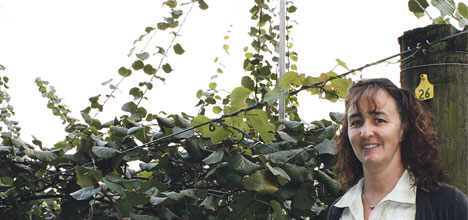
Camilla Harvey of Katikati knew with chilling certainty just how serious disease Psa-V would be, when in 2010, she learned it had infected kiwifruit vines in Te Puke.
During her years as a paediatric nurse, Camilla had seen what the bacterial family known as pseudomonas could do to human health – and she had no doubt the pathogen infecting kiwifruit vines would be hard to handle.
Camilla Harvey has recently stepped down as KVH regional co-ordinator for Katikati.
There is no risk to human health from pseudomonas syringae pv actinidiae, the bacteria the kiwifruit industry knows as Psa-V, but since 2010 it has been responsible for the death of hundreds of kiwifruit vines in New Zealand and brought about the virtual demise of the previously lucrative gold Hort16A variety.
It wasn't just her medical background which helped Camilla understand the disease. She and husband Steve own the contracting business Total Orchard Solutions, a 4 ha orchard and have 700 pollination and honey hives – so they knew all strands of their livelihood would be under threat from the bacteria.
They also knew the impacts on orchardists would be emotional as well as financial.
With a background in psychiatric nursing too, Camilla understood that support for growers would be vital in the months to follow.
Co-ordinator
So, while preparing their own business as well as they could, Camilla became regional co-ordinator for Kiwifruit Vine Health, the organisation was set up to handle the industry's response to Psa-V. In 2011, she was also among the first group of growers to travel to Italy to see the impacts of the disease there.
Many on that trip were shocked by the destruction Psa had caused to Italian orchards and were pessimistic about the New Zealand industry's ability to survive.
However, Camilla says although it was bad, she didn't believe it would mean the end of a profitable kiwifruit industry here.
She did recognise that information and support for growers would be key to helping the industry come through Psa – and this was part of her motivation to become regional co-ordinator for Katikati, a role she has recently stepped down from. However, she is still a member of the committee.
Stressful
'It was important to get information to growers about the options which were available but it was also important to make the call for growers to look after themselves too as it was obvious we were all in for a stressful time.”
Camilla says the Italy visit also taught her something about how to manage Psa-V infected orchards. 'Roberto Altobello, whose Hort16A orchard survived longer than most, talked about trying to prune only when the weather was fine and dry to reduce the opportunity for Psa infection.” Roberto also believed in reducing stress on his vines and ensuring the soil in which they grew was healthy and full of microbial activity.
The party saw other orchards where copper sprays had been used to excess, turning the vines blue with residue.
In New Zealand, Camilla says some growers pushed back against KVH recommendations for Psa management, which included the use of copper sprays, because they were concerned about their possible impact on life in the soils or phytotoxicity (an adverse reaction by the plant to the spray).
Copper
However, she and Steve decided to use coppers at the lower end of the allowable application rates, similar to those permitted for organic growers, on their own orchard and those they managed. So far there have not been any signs of phytotoxicity or a reduction in worms or microbial activity in the soils.
The Harvey orchard has been used for an independent copper trial by a product company, including applying it at different rates and mixed with oil or seaweed.
'There has been some concern that the sprays might not be giving a good coverage to the top of the canopy, which is where the airborne bacteria lands, but a trial on our orchard using florescent die showed the coverage is pretty good.
'Growers were invited to the orchard after dark when infra-red lights were used to show up the spray coverage.”
Steve and Camilla followed, and still follow other KVH recommendations for Psa management including strict orchard hygiene, cutting out any canes which show die back caused by the disease, and sealing larger pruning wounds. However, they chose not to apply the antibiotic KeyStrepto while respecting the right of other growers to do so.
Protocols
Using the industry-recommended management protocols for Psa appears to be working. Their own and most of their clients' orchards do have the disease, but all have continued to produce crops, although for most Hort16A growers this is likely to be their last harvest.
'We support growers in whatever decision they make about their orchard's future but it appears most with Hort 16A will cut the vines out this winter and re-graft. 'Last spring, some vines on two of our Hort16A orchards showed some excaudate (oozing) symptoms of the disease and were removed. But since then we have mainly seen die back and we cut it back to clean wood. 'For the orchard owner it's probably better to have someone else do that because it is hard emotionally to do so, to your own orchard.
'To growers these are not just plants.
They are vines they have invested a good deal of time and money into and for many they represent their retirement plan, both for income and a lifestyle. It's hard to see that under threat.”
Camilla is grateful their orchard and business is located in Katikati. Being away from the intensely infected 'ground zero” Te Puke region has meant so far infection rates have not been as high – and Katikati growers have been able to learn from the Te Puke experience.
New varieties
'We are also fortunate that we had planted two-thirds of a hectare of the new variety G3 in 2010, and the balance, in the green G14 in 2009 because the new vines had a chance to become established before Psa-V arrived here, making them apparently better able to cope with the infection.”
Steve and Camilla's company has recently expanded to beekeeping, with 700 hives for both pollination and honey production.
While helping run the businesses and managing an orchard, Camilla is also mum to Douglas (11) and twins Kate and Maia (8).
'Orcharding offers a lifestyle which gives us the opportunities to be involved with our children's schooling, sports and other interests.”
Helped
Taking on the role of regional co-ordinator did place more demands on her time but Camilla says in many ways it also helped her cope with the stress of Psa.
'Talking to growers, reading technical information and then helping ‘translate' it into more grower-friendly language; and learning about what management practices work for others helped me too.
'It also helps, even now, knowing that we have done everything we can to protect our vines so I don't worry quite so much now when it rains, because I know we have taken all the precautions we can.”
Despite some dire predictions about the industry's future when Psa-V was first discovered –it hasn't collapsed.
Camilla is confident, thanks to the New Zealand industry's unified structure, significant research and development underway, and the 'number eight wire” innovative and tenacious nature of orchardists, the kiwifruit industry has a bright and sustainable future.

0 comments
Leave a Comment
You must be logged in to make a comment.