


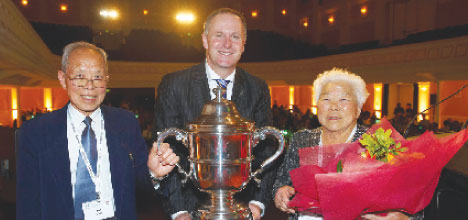
Growing food is a service to mankind, says Fay and Joe Gock, who with 60 years of dedication and achievement have been recognised with horticulture industry's highest honour, the Bledisloe Cup.
The market gardening pioneers of Pukekohe were presented the cup by Prime Minister John Key at the Horticulture New Zealand conference in Wellington.
Joe and Fay Gock with horticulture industry's highest honour, the Bledisloe Cup, presented to them by Prime Minister John Key.
Joe Gock says he was overwhelmed by the honour.
'I thank the Good Lord for this honour. I have a lot to thank New Zealand for. I came here in 1940 as a refugee and was supposed to leave after the war. But now I'm 85 and still here. New Zealand is so good not to have kicked me out.
'I thank this beautiful land for what it has given us and the beautiful people who have been so kind and generous. I see growing food as a service to mankind. My father began by growing food for the troop.
'I like growing and I like the outdoors. The work makes me feel young.”
Fay says she was never a grower until she married Joe, but she too sees producing food as a service to mankind. 'We need good food to keep healthy and all we want to do is grow good food.”
In more than six decades of commercial fruit and vegetable growing, the couple have used innovation, including being the first growers in the world to put labels on individual pieces of fruit.
HortNZ president Julian Raine thanked the Gocks, who are both in their 80s and still growing crops, for decades of selfless and hugely valuable service to the industry.
Pioneers
'Fay and Joe are completely passionate about horticulture. They have pioneered new approaches in growing, new packaging techniques and new technology which have hugely benefited many New Zealand growers. 'They have given their time and their stock, generously providing advice, assistance and mentoring to other growers over many years, as well as providing work and support for several generations of local families; and they've donated to schools and the underprivileged of Manukau City over a number of years,” says Julian.
'Their contribution to the industry, as well as their community, has been outstanding and we are delighted to recognise it in this way.”
Joe Gock left his native China for New Zealand with his mother in 1940 at the age of 12, to join his father who was market gardening in Hawke's Bay.
At 16 he began working alongside his father in Clive before they moved to Auckland, leasing 30 hectares of land in Mangere.
Fruiterer
In 1956 he married Fay, daughter of a fruiterer, and they started their own growing business. The Joe Gock business was the biggest market garden in Mangere – out of nearly 100 – from the 1950s to the 1980s.
They have grown kumara for nearly 60 years and were the largest growers in New Zealand in the 1950s. They were the first to raise kumara tubers by using under-earth heating in modern hotbeds.
Through rigorous selection they developed a disease-free kumara strain which became known as O-wai-raka Red. In the late 1950s, theirs was the only disease-free stock in Auckland and when Ruawai and Dargaville stock was devastated by black rot they donated their stock, through the then Department of Science and Industry Research (DSIR), to help re-establish crops.
They also pioneered, with DSIR, a prototype kumara curing shed, reducing crop loss from 50 per cent to less than one per cent, enabling kumara to be marketed all year round.
They pioneered the growing of seedless watermelons and, to distinguish this in the market, were the first growers in the world to place stickers on individual fruit – a practice which is now commonplace internationally and an important marketing and traceability tool.
In the 1980s they grew large quantities of broccoli, a relatively new crop at the time. Unable to find suitable packaging for the freshness they required for transporting it, Joe developed and patented the Gock bushel-size polystyrene box, which can be packed with ice and are still used in the industry today.
Rhubarb
The Gocks are also among a handful of commercially-successful rhubarb growers, which they have exported to England and Japan. They also led the industry in the use of modern carrot washing equipment in the 1970s.
They have been loyal and active members of the Chinese Commercial Growers Association since the 1950s, mentoring many young growers. They still grow dwarf beans, cos lettuce, capsicums, cauliflowers, rhubarb and kumara.

0 comments
Leave a Comment
You must be logged in to make a comment.