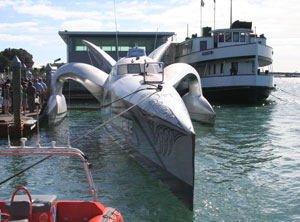
It has horns, wings and a very long snout - by any standard the wavepiercing trimaran Earthrace is a strange beast.
From a distance Earthrace's profile on the water at rest is almost military. She has the same purpose-built design ethos. Her performance is better than anything the government has provided the RNZN, and at $US1.5 million, she's a far cheaper all weather platform.
She's also stealthy. The large amounts of carbon in the construction don't reflect radar very well. While in US waters Earthrace kept disappearing off the Coastguard radar. The galvanised steel reflector on the top of the port spar was the alternative to calling in every half hour to provide a position report.
Earthrace is for sale, but the only interest so far has been civilian. Skipper Pete Bethune says two private offers have fizzled. He's more excited about interest from the Sea Shepherd Conservation Society.
The Steve Irwin, the society's Japanese whaler watch vessel can only make 16 knots, while the Japanese whalers can make 22 knots.
Earthrace can travel at 25 knots for extended periods, and has an ocean crossing range and a proven all weather ability.
Rough water doesn't slow her much. The wave piercing design means Earthrace travels through waves while partially submerged – like a surfer ducking under the break while scratching out.
She's designed for seven metres submerged, or seven metric tonnes of water pressure over the hull.
During the race the cockpit windscreen just forward of the spars, was regularly five metres under waves.
The horns are the engine exhaust and intakes. There are drains to vent water when they are submerged and there's enough air in the hull to keep the twin Cummins QSC 450 turbo-charged diesels running without missing a beat.
The horns took a couple of bullet holes from the Columbian Navy which was trying to make a point during the first record attempt.
The wings are the spars supporting the floats. They have picked up their own scars recently, graffiti that Pete is not happy about.
Earthrace's long snout is the accommodation. Twelve bunks and lockers.
Like every interior surface, there is writing everywhere. Names and messages from some of the 200,000 people who have been on board Earthrace.
The last time Earthrace was in Tauranga was three years ago, and Pete has seen a lot of ports since then.
'This is one of the prettiest harbours I've been in,' says Pete. 'With Mayor Island, the Mount, it has wonderful character.”
Earthrace runs 100 percent biodiesel. Pete says Cummins rebuilt the motors after 8000 hours and found engine wear was comparable with fossil fuels, but in different parts. The sleeves had less wear and there was more on the injectors.



14-Dec 07:00
Summer Smarts #4: Are your older neighbours okay?
14-Dec 06:00
Ocean swimming group thrives despite battles
13-Dec 16:19
Summer happiness is strawberries and roses
13-Dec 14:00
Retirement village rule changes strengthen rights
13-Dec 12:16
Greerton Garden Club on the move
13-Dec 10:00
Tauranga student’s leadership shines
13-Dec 09:00
Christmas parade delivers ‘fabulous’ day
13-Dec 06:00
Artwork lights up Hobec’s new home
12-Dec 18:00
Watch Tauranga's waka welcome for new cruise ship
12-Dec 17:00
Tauranga Special Olympian chasing big goals
12-Dec 16:00
Christmas magic at The Arts Junction
12-Dec 14:59
Public tip-off leads to Whangamatā meth bust
COMPETITIONS

0 comments
Leave a Comment
You must be logged in to make a comment.