


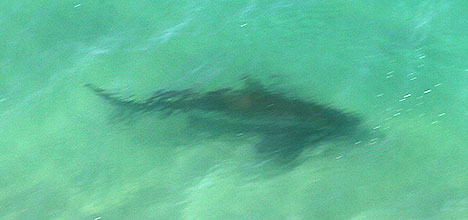
The sighting of a bronze whaler shark skirting the breaker line at Papamoa is the first shark sighting this summer, says Mount Maunganui head lifeguard James Roy.
'We haven't had any sightings here, zero sightings. We are not a beach that gets a lot of sightings anyway, I wouldn't say it's unusual for us not to see a shark over a season,” says James.
A bronze whaler shark spotted off Mount Maunganui beach in 2013. Photo: Tracy Hardy.
The bronze whaler shark, estimated to be about 2-3metres, was spotted near swimmers at Papamoa Beach on Tuesday afternoon, according to media reports.
There are no recorded instances of a bronze whaler ever attacking a swimmer along Mount Maunganui beaches.
Bronze whalers, which on average are 1.5–2.5metres in length, are commonly found around the North Island, and cruise along the 20kilometres of ocean beach from Mount Maunganui to Papamoa East.
As a rule bronze whaler sharks are not known to bite humans, though they are known to poach spearfishers' catches. Their teeth are designed for grasping small prey, such as slippery fish and squid, rather than for cutting big hunks of flesh. They have 63-65 functional teeth, and these are about 20-30 mm in height.
'At 3metres long, bronze whaler sharks can get quite large,” says NIWA Principal Scientist, Dr Malcolm Francis.
'Bronze whaler sharks occur in pairs or in small groups. Sightings increase at this time of the year, partly because more New Zealanders head for the beach in summer, but also because they come into warmer waters to chase fish or give birth to their young,” says Malcolm.
Bronze whalers give birth to live young and mate soon afterwards, which is why there may be males hanging round the Mount beaches at this time of year as well, says Malcolm.
The bronze whaler is one of the largest reef shark species, and one of the most abundant large shark species in New Zealand coastal waters. It is also the species most likely to be encountered by divers, surfers and swimmers around New Zealand, from Cape Reinga to Cook Strait.
They live in shallow coastal waters during the summer – reefs, bays, estuaries and surf beaches, and in winter are found further offshore, according NIWA.
Bronze whalers have an incredibly good sensory system and they are very adept at learning about, and exploiting their environment.
'They learn well in choice experiments,” says Malcolm.
They are not normally aggressive towards humans, although spear fishers have been bitten by excited sharks. However, they are opportunist eaters, which mean that they will eat live or dead animal matter.
They mainly eat small schooling fishes such as kahawai, jack mackerel, sardines, pilchards – all of which can be found just behind the breaker line
'Sharks have a lateral line sense which can detect vibrations in the water. If you're in the water and see a shark, don't splash about and don't panic. It's highly unlikely that they will bite you,” says Malcolm Francis.
Their eyesight is probably limited only by the visibility of the water. They may be able to see tens of metres, as far as humans can, under water.
The bronze whaler is bronze to grey-brown in colour. Their underbellies are cream in colour. The first dorsal fin is large relative to the second, and the tail's upper lobe is 2–3 times longer than the lower lobe.
Their skin is thick and leathery to touch with denticles, which are like small teeth, embedded in the skin. These channel water-flow over their bodies, for easily slipping through the water.
Papamoa lifeguards could not be reached for comment.
Did you see the shark? Email [email protected] or phone 0800 SUNLIVE.

0 comments
Leave a Comment
You must be logged in to make a comment.