


By the time the Ministry for Primary Industries became aware of the new insect pest Giant Willow Aphids late last year it was too wide spread throughout the country to make eradication feasible, says a spokesperson for the ministry.
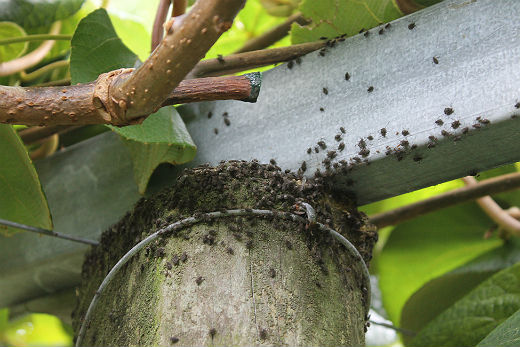
Early this week the aphids were found crawling on fruit, vines and support structures on Neil Brough's gold kiwifruit orchard and he is concerned they may trigger the fungus sooty mould to grow on his fruit, making it unsuitable for export.
Read more here.
Aphids on Neil Brough's Omokoroa orchard.
MPI says it was notified by phone of a suspected find of the giant willow aphid in Auckland on December 24.
A specimen was sent to the ministry on January 8 and it was formally identified on January 13. The situation was subsequently assessed and investigations found that the aphid was present in Northland, Auckland, Bay of Plenty, Gisborne, Wairoa, Wairarapa, Taranaki and the Tasman District in the South Island.
'As such, containment of this widespread species was not feasible. In addition, there are not any feasible eradication tools available to treat this species over such a wide area,” an MPI spokesperson told SunLive.
'Aphids do secrete honeydew when they are feeding. However kiwifruit is not known to be a host plant for this species (i.e. they are unlikely to feed on kiwifruit vines), so it is not likely that honeydew would be an issue unless significant populations of them are present in willow shelter belts nearby.”
Honeydew secreted on plants and fruit can cause the growth of a black fungus known as sooty mould.
'As kiwifruit is not currently known to be a host to this species, the aphid feeding on vines is not thought to pose a threat to the kiwifruit industry.
'These aphids may be present on vines and vine structures but this would most likely be transient as they move to other host plants.
'As its name would suggest, it is associated with willows (and occasionally poplar). Sooty mould appearing on kiwifruit due to honeydew contamination from the aphid feeding on adjacent shelterbelts could potentially occur.”
MPI says it is working closely with the kiwifruit industry on this issue and has been in regular contact with Kiwifruit Vine Health, sharing investigation information.
'MPI expects to further work with industry to further clarify the status of kiwifruit vines as a host for giant willow aphid.”
However, the ministry has not received any notification of a problem at Neil's Omokoroa orchard, and does not have samples so cannot confirm the actual identity of the insect involved.
The spokesperson says MPI encourages the grower concerned (and indeed all growers noticing unusual insects/plant disease etc) to call its 0800 number (0800 80 99 66) and report the situation. This enables the Ministry to investigate, determine the insect involved and potentially rule out it being something of concern.
'Our first advice is to report the unusual and unknown insects to the pests and diseases hotline – 0800 80 99 66.”
Growers who positively identify giant willow aphids on their orchards are best placed to manage this aphid and should talk to their horticultural consultant as to appropriate chemicals or treatments, the spokesperson says.
MPI says it is working closely with the kiwifruit industry on this issue and has been in regular contact with Kiwifruit Vine Health, sharing investigation information.
'MPI expects to further work with industry to further clarify the status of kiwifruit vines as a host for giant willow aphid.”

1 comment
Change of diet
Posted on 15-02-2014 18:15 | By Johnney
We never used to eat sushi, KFC and McDonalds. Maybe the aphids diet has changed as well.
Leave a Comment
You must be logged in to make a comment.