


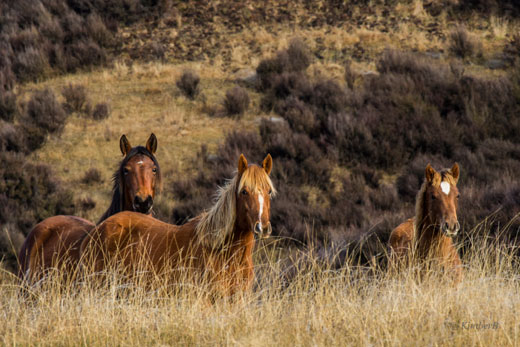
Kaimanawa horses are living history, testament to their own survival skills
and the resilience of their forebears, believes Elder Jenks, chairman of Kaimanawa Heritage Horses.
'When I first learned the story of the Kaimanawa horses, I was amazed. These remarkable animals have survived in one of this country's harshest environments for 150 to 160 years without any human help. They have had to find their own food and water, and make it through the winter snows.”
Their ability to do so goes back to their ancestors, Elder believes. 'The horses can be traced back to Arab, Exmore and Welsh ponies brought out from England by sailing ship, itself a feat of survival,” says Elder.
The first wild horses were recorded in the Kaimanawa mountain ranges in 1876. Escapees and releases of horses from farms and the cavalry at Waiouru have added to the gene pool as have ‘Desert Road drop-offs' of other unwanted horses.
Today, the characteristics of the Thoroughbred, Arab, Standardbred and Clydesdale can be seen in horses living in separate geographical areas within the Kaimanawa population.
Elder says the horses live not in herds, but in family groups and some are distinctive for their larger stature, probably the influence of Clydesdale blood lines.
Struggling
In the 1990s, when the population had reached more than 2000, the horses were struggling and were in poor condition due to lack of food. In 1992, the Department of Conservation reported that up to 31 different unique plant types existing in the area were threatened with extinction due to horse trampling and grazing damage. A systematic programme of culling horses through aerial shooting was put in place. But animal welfare groups opposed these slaughters and brought public opposition to the programme.
The first muster was undertaken in the winter of 1993 when 310 horses were culled. The largest muster was in 1997 when 1100 horses were culled off the ranges. To date, about 2000 horses have been removed from the Kaimanawa Ranges, but more than half have been slaughtered.
The aim is now to manage 300 horses in the wild. While the numbers are small, Elder says neither the environment the horses live in, nor the animals themselves, can withstand large herds.
Today, Kaimanawa Heritage Horses works closely with the Department of Conservation to co-ordinate the biennial musters and find homes for as many horses as possible.
118 saved
'Last muster in 2012, 192 horses were removed from the herd and we saved 118 of them. We always aim not to let any foals or yearlings go for slaughter and to save as many mares and young males as we can,” says Elder.
The next muster will be in late May or early June this year and anyone interested in taking a Kaimanawa horse can apply to do so on the Kaimanawa Heritage Horse website now.
Each applicant will be visited by an inspector to ensure they have the facilities and skills to provide a Kaimanawa horse with a home, which is safe for both horse and owner.
'These are after all wild horses which don't know about fences and are not used to being around people, so we don't want them or people injured. However, with the correct facilities and handling, Kaimanawa horses become quiet and make wonderful riding horses,” says Elder, who has never ridden a horse himself. It was his wife Marilyn who first introduced him to Kaimanawa horses – and 15 years on, the couple continue to work hard for the welfare of the unique animals. They are deeply involved in Kaimanawa Heritage Horses, a charitable society run by a volunteer group of passionate horse people dedicated to the care and welfare of Kaimanawa horses both domestically and in the wild.
To find out more, or to apply for a horse from the next muster, go to: www.kaimanawaheritagehorses.org

0 comments
Leave a Comment
You must be logged in to make a comment.