


Huge variation in maize dry matter continues to be an issue both within and between fields.
This is influenced by rainfall, soil type and compaction, topography, proximity to hedges, trees, plant population, and drought-tolerance of the hybrid planted.
Given this variability, how can you determine whether your drought-stressed crop is ready to harvest at the 30 to 40 per cent dry matter stage?
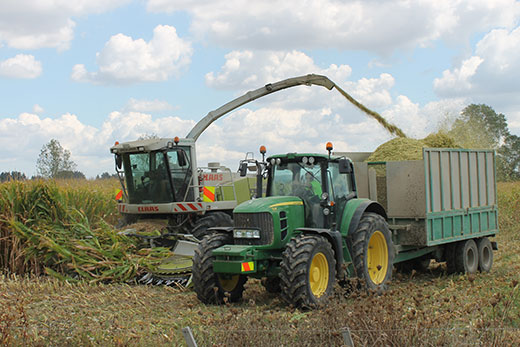
Co-ordination is essential: harvester and tractor drivers work in unison to harvest a maize silage crop on a farm near Te Kauwhata.
Expert advice is available from a number of seed and supply company representatives and contractors' agronomists, so seek their advice and book your contractor well in advance –phoning a couple of days before harvest is not helpful.
Remember drought-stressed crops with few kernels or little kernel development can have high nitrate levels.
If green chop is required urgently for hungry animals, get a sample to your vet for nitrate testing before feeding.
This testing is usually a same-day service. However, should you wish to assess the crop yourself here are a few pointers:
Stand on a high point and ascertain what percentage of the field is still green (particularly from the cob upwards), what percentage is a lighter green but still has folded leaves (particularly during the heat of the day), and what percentage is completely brown and dead.
If the majority of the paddock is completely brown, harvesting as soon as possible would be recommended.
If the majority of the paddock is green, check the milk line in the kernels, husk cover colour and how many leaves below the cob are totally brown and senesced. As a general guide: if the milk line is starch from the cap to a third, husk cover is turning brown, and the lower leaves are senesced, then contact your contractor.
Alternatively, three or four representative plants can be mulched and DM determined by laboratories or simple microwave testing and weighing.
Leaves from the cob upwards, if still green will still continue to photosynthesise and produce further DM and yield in the plant.
The last few weeks can add a lot of grain weight and size.
DM in Waikato crops that had lost all green leaf colour below the cob was up to three per cent higher than you'd expect if those leaves were still green. This is because the drought stressed stover was becoming very dry, even though kernel milk line development was not well advanced.
Apart from peat soils (where plants roots can access moisture), most drought stressed northern Waikato/Dargaville region crops are drying down at least one per cent a day.
This dry down will be slower in some areas of the Waikato (especially south Waikato), due to better rainfall, but the amount by which it has slowed very much depends on the amount of rainfall received.
Many contractors now have NIR DM determination capability on their choppers, and chop-length can be altered to aid stack compaction and the fermentation process of the maize silage.
The dry weather means herbicide residues may remain in the soil after harvest and affect subsequent grass seed germination. You can check this by carefully placing the top 100mm of representative soil in a plant tray, sowing some mustard seed, watering and then checking for normal germination and plant health.
Soil nutrient levels following harvesting are likely to be higher than normal, due to lower yields and low leaching. This may translate into fertiliser savings for the subsequent crop.
(Source Maize Action – Foundation for Arable Research newsletter).

0 comments
Leave a Comment
You must be logged in to make a comment.