


Western Bay road police say they're getting the message across to car and motorbike enthusiasts that vehicles with noisy and loud exhausts are unwanted in the Tauranga City.
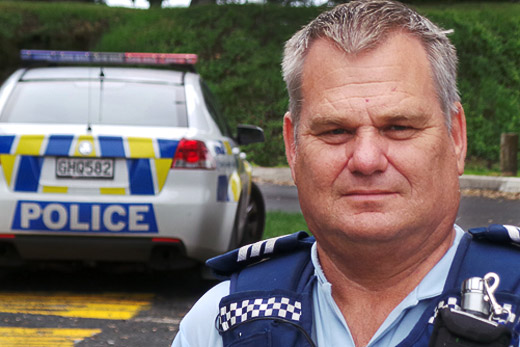
Acting Western Bay of Plenty road policing manager Senior Sergeant Wayne Hunter.
Western Bay of Plenty Road Police launched a year-long noise blitz campaign in February in attempt to reduce unwanted levels of excessive noise made by modified cars and exhausts on motorcycles.
If found exceeding the desirable levels, motorists are facing fines of up to $600 and the loss of 25 demerits.
Acting Western Bay of Plenty road policing manager Senior Sergeant Wayne Hunter says the campaign has started off on a positive note, with very few cars spotted nearing the two-month mark of the campaign.
'All we are doing is targeting these boy racer-type vehicles and doing regular checks; and if we believe they are not basically following these regulations, a ticket will be handed out,” says Wayne.
'I think there hasn't been an upsurge at all, I think it has gone down and there is not as many coming through.”
The year-long campaign comes after police dealt with a series of noise complaints during the peak summer period – something seen to detract from the region.
Complaints ranged from noisy or defective exhausts, noisy equipment in vehicles like boom boxes and stereos, through to operating noisy vehicles in an inconsiderate manner.
Wayne feels the police's constant presence on the issue is beginning to make progress throughout the area, with noise levels only elevating during summer thanks to throngs of holidaymakers.
'We haven't had that issue, touch wood, for a while because we have given them the message that they aren't welcome here.
'It's [the $600 fine and 25 demerits] a good incentive to tone it down in some ways.”
Offenders can expect fines between $50-600, the loss of up to 25 demerits, and can also be subject to an objective noise test by an NZTA accredited certifier.
The test costs about $200 and involves a stationary tail pipe test, based on international standards.
Motorists are reminded if they do modify their vehicles to remember the national motoring laws.
By law, the noise coming from a motorist's exhaust system must be similar to or less than the noise it made when the vehicle was manufactured.
Two exceptions are where: the noise the exhaust emits is still well below legal noise limits; and an objective noise test proves the noise does not exceed the legal noise limits.
The noise limit for cars is measured at the exhaust while stationary. Police have the power to refer excessively noisy cars for a formal noise test, and Warrant of Fitness inspectors are able to refer noisy cars.
If the vehicle passes the test, a certifier will attach a label to the vehicle verifying it meets requirements. If the vehicle fails the test, the owner cannot legally drive it on the road until the exhaust is repaired.
In 2008 a widely-supported move to lower New Zealand's noise limit from 95 to 90 decibels took effect for all new registrations. The new noise rule combats illegally-modified boy racer cars, but not genuine factory-modified performance vehicles.
Most cars imported into New Zealand already meet the stricter 90 decibel limit – including performance vehicles.

6 comments
Safety Issue ??
Posted on 13-04-2014 14:12 | By mutley
Interesting that the Police have put resources into this non-safety issue yet appeared to completely ignore Tyre Awareness Week. For anyone who missed it - it was last week. Why do the Police spend taxpayers money replacing their own tyres at 3mm tread depth yet don't give the public motorists the same message ? A cynical view would relate to revenue gathering and that there is no money in tyres for the Police - much more public support for fining boy racers. 73 people died between 2008 and 2012 due to bad tyres. Nobody died from noisy cars.
Why 3mm
Posted on 13-04-2014 20:41 | By Murray.Guy
A reasonable guess for greater tread depth on a Police vehicle might be that it may be used at speeds much greater than the speed limit, and in all likelihood, in response to an accident during inclement weather. Let's not forget, the tread is mostly for the wet! Why a non safety focus - revenue, plus tick a few boxes for when a select few complain of a noisy vehicle, and a bit of 'car enthusiast bashing'! '73 people died between 2008 and 2012 due to bad tyres', is a bit of a stretch. 'May have contributed to ...' is likely more accurate.
It does seem strange...
Posted on 13-04-2014 21:10 | By groutby
That these "issues" being highlighted recently by the police (and the TCC) are both concerns taken care of within the "old" WOF 6 monthly test..excess noise/oil burning and certainly tyre tread depth etc is surely part of this. There is something else behind this recent push to annoy the motoring public...are there any police out there catching "real crims" now?
non-safety issue
Posted on 13-04-2014 22:30 | By Capt_Kaveman
ever had your drivers window down when a loud boyracer passing up a hill under heavy throttle? made my ears ring for days motorbikes the same, i dont need no device to tell if one is loud what hearing i have left is enough to decide
Mindboggling!
Posted on 14-04-2014 08:23 | By penguin
The mind wrestles with the concept as described in the report above"...with noise levels only elevating during summer thanks to thongs of holidaymakers". Could be quite a spectacle!
Noisey Motorcycles.
Posted on 14-04-2014 09:08 | By Axeltic
Reading this article has cleared up a question I have always wanted an answer to. How come Harley Davidson bikes can make so much noise. As long as they are not exceeding the noise made when new. It is Ok. Thanks for clearing that up. Cheers Dennis.
Leave a Comment
You must be logged in to make a comment.