


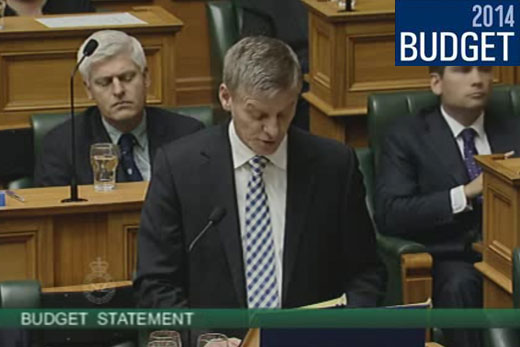
The Government has announced its 2014 Budget focusing on supporting families and returning to surplus.
Finance Minister Bill English announced a forecast $372m surplus next year and increasing surpluses in subsequent years with the economy growing by between 2 and 4 per cent annually in the next four years.
A key feature is a $500 million support package for young families and vulnerable children who need protection and care, says Prime Minister John Key.
'The Budget shows the economy is continuing to build momentum and provides further evidence that the Government's programme is on the right track,” says the Prime Minister.
'But what actually matters to families and vulnerable New Zealanders are the opportunities created by a sustainable economic recovery.
'A strong economy supports more jobs and higher incomes, and allows us to provide important public services such as health and education that New Zealanders rely on.”
Here are some key features of this year's budget. What do you think?
$500m package for families
The package has five parts, and over the next four years will include:
- $172 million to boost the paid parental leave scheme. Paid leave will be extended by four weeks – starting with a two-week extension from 1 April 2015, and another two weeks from 1 April 2016.
- The eligibility of paid parental leave will also be expanded to include caregivers other than parents (for example, permanent guardians), and to extend payments to people in less-regular work or who recently changed jobs.
- $42 million to increase the parental tax credit from $150 a week to $220 a week, and increase the entitlement from eight weeks to 10 weeks, from 1 April 2015.
- $90 million to provide free GP visits and free prescriptions for children aged under 13, starting on 1 July 2015.
- An additional $156 million to help early childhood education centres to remain accessible and affordable, meet demand pressures and increase participation towards the Government's 98 per cent target.
- $33 million in 2014/15 to help vulnerable children, including eight new children's teams around the country to identify and work with at-risk children and their families, to screen people who work with children, and to support children in care.
Economy
The Government remains on track to meet its two fiscal targets – getting back to surplus in 2014/15 and bringing net core Crown debt back down to 20 per cent of GDP by 2020.
Surplus
Budget forecasts show the operating balance before gains and losses in surplus by $372 million in 2014/15, increasing to $1.3 billion, $2.4 billion and $3.5 billion respectively over the following three years.
Finance Minister Bill English says it's a sharp improvement on the $18.4 billion deficit in 2010/11 and the $3.9 billion deficit the Government inherited in 2008/09.
Net debt is expected to fall to 20 per cent of GDP in 2019/20, in line with the Government's target. This includes the impact of resuming full contributions to the New Zealand Superannuation Fund in 2019/20.
Net of reprioritisation, the cost of the Government's new spending and revenue initiatives over the past six Budgets have totalled less than $2.7 billion in the final year of the forecast period. By comparison, the last six Budgets of the previous Government totalled $20 billion.
Core Crown expenses have fallen from around 34.4 per cent of GDP in 2008/09 to a forecast 30.3 per cent of GDP in the 2014/15 financial year. They are then expected to go under 30 per cent of GDP and stay below that level.
The Government will stick to its $1 billion a year operating allowance in this Budget. The allowance will increase to $1.5 billion in Budget 2015 and then by 2 per cent a year.
Treasury advises that lifting the annual allowances to $1.5 billion a year is around the upper limit for increased spending without materially impacting on interest rates, says Bill.
New Zealand's economy grew by 3.1 per cent in 2013 – the fifth-highest in the OECD.
The Budget forecasts show growth of between 2 per cent and 4 per cent over each of the next four years, with growth forecast to peak at 4 per cent in the year to March 2015.
Wages
The average wage increased by $3,000 in the past three years to $54,700. Based on the latest growth forecasts it is expected to increase by a further $7,600 to $62,300 over the next four years.
ACC
ACC levies for households and businesses to fall by close to $1 billion since 2011/12.
The Budget indicates ACC is on track to further reduce levies by around $480 million in 2015/16, subject to public consultation by ACC.
Depending on the outcome of that consultation, the average levy for a private motor vehicle could fall by around $130 a year from 1 July 2015.
Tax Cuts
Kiwi businesses investing in research and development will benefit from two new tax measures as part of Budget 2014.
Loss-making start-up companies will now be able to cash out all or part of their tax losses from research and development expenditure, while all businesses will be allowed tax deductibility for R and D 'black hole” expenditure that is currently neither deductible nor able to be depreciated.
The two initiatives are estimated to return a net $58.1 million in tax to companies over the next four years, and both are part of the Building Innovation stream of the Government's Business Growth Agenda.
The two measures will mean:
• R and D-intensive start-up companies will have early access to all or part of their tax losses in the form of a cash receipt, rather than carrying these losses forward.
• All capitalised costs on depreciable, intangible assets (for example, patents) will be deductible over time.
Paid Parental Leave + families
Paid parental leave is set to increase by four weeks with the Government boosting spending by $171.8million over the next four years' to enhance parental leave provisions.
From April 1, 2015 the current 14 weeks rises to 16 before another two weeks the following year.
- Women can currently get up to 14 weeks' taxpayer-funded paid parental leave (PPL). To qualify, they must have worked regularly for the same employer, or have been self-employed, for an average of 10 hours a week for at least the previous six months.1 Parental leave payments can be transferred to a spouse or partner.
- PPL replaces the employee's earnings up to a maximum payment. Currently this is $488.17 a week before tax.
- Women can also be entitled to up to 52 weeks of employment-protected unpaid parental leave, if they meet the criteria.
Lower and middle income families with new born babies are set to benefit from the Government extending the parental tax credit by $70 and an extra two weeks from next year.
Parental tax credit will increase from its current maximum amount of $150 a week to $220 a week.
There is also an increase in the period for which the tax credit is paid, from eight to 10 weeks following the birth of a child.
- For babies born on or after April 1, 2015, the Government will increase the PTC from $150 a week to $220 a week, and extend the payment period from eight weeks to 10 weeks.
- This increases the maximum payment under the PTC from $1200 to $2200.
- As a result, up to 1200 additional lower-income families are expected to claim the PTC, because it will pay them more than they would otherwise get from paid parental leave. (People cannot claim both of these payments).
- In addition, the rate at which the PTC reduces will increase from 3.26 cents to 21.25 cents for each additional dollar of family income, to put it in line with the rest of the Working for Families scheme.
Housing
The country's Social Housing Fund continues to be propped up with an additional $30million in the next three years, helping grow the community housing sector and fast tracking homes for high-need families.
The $30m, at $10m each year, is in addition to the $77.5m of new operating funding and $18.2 million of new capital funding for improved assistance to social housing tenants announced by Minister for Social Development Paul Bennett.
- $64.3 million new operating funding and $16.4 million new capital funding for social housing needs assessment functions at the Ministry for Social Development.
- $30 million boost from 2015/16 to the Social Housing Fund to help increase the size of the community housing sector.
- $8 million to support higher social housing tenant mobility.
- $5.2 million new operating funding and $1.8 million new capital funding for reviewable tenancies to ensure reviews are thorough and careful.
- $75 million for a Christchurch housing contingency.
Health
As part of its $500 million Budget, the Government has $1.8b to be spent on health during the next four years for new initiatives and to meet cost pressures and population growth.
This is made up of $1.39b of new money and $412m of savings.
GP visits
The main focus of the investment is children's GP visits and prescriptions – making both free for under children aged under 13 from next July. Until now limited to children aged under six, this will benefit more than 400,000 primary school-aged children.
- $90 million to provide free GP visits and free prescriptions for children aged under 13 from July 1, 2015.
- Extra $23.7 million to support general practices. This includes $8.9 million extra funding for rural general practices and a further $13.3 million to provide one-third of New Zealanders with low-cost doctors' visits.
Elective Surgery
Elective surgery funds will be boosted with an additional $110m, going towards more hip and knee replacements, $10 million during four years for bariatric surgery.
Cancer services
- $32.7 million to further improve cancer services and provide better support for cancer patients includes funding for specialist psychological staff and up to 20 cancer support workers.
- $8m to further reduce waiting times for colonoscopies, which can identify if a person has cancer or pre-cancerous growths called polyps that can be removed easily.
- $5.4 million for breast and cervical screening programmes, to ensure more women receive high-quality screening services.”
Other health areas:
- An extra $112.1m for disability support services to meet rising needs and costs.
- $96m for home-based support services.
- $40m for a new Healthy Families NZ campaign to encourage New Zealanders to eat healthier and exercise more.
- $40m for additional support for elderly people including people with dementia (details to be announced later).
- $17.8m for post-graduate education and training of doctors.
- $6.3m to provide bilateral cochlear implants for children under 18.
- $4m to increase the number of renal transplants performed.
- A further $20m for the rheumatic fever prevention programme.
Tobacco tax
As announced last week, the duty-free tobacco allowance will fall from 200 cigarettes to 50 cigarettes, in line with the allowance in Australia.
Education
The Government will invest $857.8 million over the next four years and the remainder of this year for new education initiatives and sector support.
An additional $156 million to help childhood education centres 'remain accessible and more affordable, meet demand pressures and increase participation towards the Government's 98 per cent target”.
The Budget also allows for $858 million of new money for education and $199 million in tertiary education.
Other areas where the money is going to include:
- $359 million to invest in educational success by strengthening leadership and quality teaching across schools.
- A further $85 million for schools' operational grants.
- $111 million of operating funding to support school property development.
- $172.5 million capital and $111.5 million of operating funding for school property development and maintenance over the next four years, including:
- $172.5 million capital and $38.1 million operating funding for new schools and expansion on existing school sites.
- $29.8 million of operating funding for the recently opened schools at Hobsonville Point in Auckland, procured through a public-private partnership development.
- $16.9 million of operating funding for the property components of the Greater Christchurch Education Renewal Programme.
- $10.4 million to fund compensation claims to remediate leaky buildings, as well as building improvement activities to protect the value of Crown assets.
- $8.5 million in 2014/15 to cover increased insurance premiums following the Canterbury earthquakes.
- $7.8 million to improve management of the school property portfolio.
- $4.7 million of operating funding over four years to provide additional teacher aide support for students with high health needs to safely attend school.
- An extra $2.4 million of operating funding over the next four years will go to the Reading Together Programme so it can expand to include more than 140 decile 4 and 5 schools.
Law and order
The police's core operating spending is being maintained at $1.46 billion in 2014/15.
The next phase of policing will focus on further improvements in the way the service operates, to provide more effective frontline policing and crime prevention.
This includes:
- Increased foot patrols and frontline staff – the equivalent of 354 extra officers.
- $109 million is available to justice sector agencies in the Justice Sector Fund for initiatives which contribute to meeting the Government's priorities, including the Better Public Services targets of reducing crime and reoffending.
- Funding for the Serious Fraud Office reverts to baseline of $7.6 million in operational funding in 2014/15 following the temporary boost to investigate and prosecute finance companies.
Environment
- $20m for freshwater and environment initiatives to help the management of New Zealand's natural environment.
- Three additional Centres of Research Excellence (CoREs) will operate from 2016. The budget boosts CoREs operating funding by $53m during four years, with annual ongoing funding increasing to $49.8mfrom 2016/2017 to support the additional CoREs, bringing number funded to 10.
- $15.8 million of operating funding and $10.7 million of capital funding during the next four years to ramp up measures to protect New Zealand's magnificent kauri forests from the dieback disease.
Other areas:
Building materials
Duties on plasterboard, reinforcing steel bar and wire nails and tariffs on building products like roofing, cladding, insulation, paints, electrical and plumbing fittings will be removed temporarily to increase competition and improve housing affordability.
The reduction in duties and tariffs from this initiative will reduce Crown revenue by $27.8 million over five years and has been provided for in Budget 2014.
Share offer proceeds allocated
The success of the Government's share offer programme provides a further $1 billion of new capital investment.
'The share sale proceeds saw $4.7 billion go to the Future Investment Fund and we said we would spend $1 billion of that on schools, and a further $1 billion on health,” he says.
Education is allocated $172.5 million in Budget 2014 to continue the upgrade and replacement of school buildings, and to build new ones.
KiwiRail receives a further $198 million from the Future Investment Fund, of which $150 million is earmarked for infrastructure. An additional $25 million covers Aratere-related costs.
$375 million of new capital for the New Zealand Transport Agency, by way of an interest-free loan, to accelerate $815 million worth of Auckland transport projects.
Other spending allocated from the Future Investment Fund in Budget 2014 includes:
- $75 million for a Christchurch housing contingency.
- A further $40 million to Crown Irrigation to invest in the design and construction of irrigation schemes to boost agricultural production.
- $30.6 million towards the Hobsonville Land Company housing development.
- $11.3 million towards the Crown buying the TVNZ Archive at Avalon.
- $8 million on Te Papa for maintenance and repair.
Youth
$8.6 million of new operating spending over the next four years for social support needs at Youth One-Stop Shops and Youth Affairs.
Maori Initiatives
- $8 million in operating funding over four years towards a Maori Innovation Fund.
- $6 million in operating funding over four years towards New Zealand Maori Tourism.
- $1 million, of which $500,000 is in new operating funds and $500,000 reprioritised spending, for a joint New Zealand Māori and Chinese stage production.
- Iwi radio will receive an extra $12 million over the next four years to support the operational costs of the 21 stations currently funded by Te Mangai Paho and to assess the feasibility of expanding the iwi radio network
- A Maori Centre of Research Excellence (CoRE) will be funded as part of the Government's increased investment in research excellence.
KiwiRail
$198m for KiwiRail's Turnaround Plan
- Infrastructure renewals and upgrades.
- New wagons and refurbishment of existing wagons and locomotives.
- IT systems.
- Earthquake remediation projects and other safety works.
Christchurch Earthquakes
Efforts to help Canterbury rebuild from the Christchurch earthquakes have been given an extra $50million for recovery during the next two years.
The extra funding, for the Canterbury Earthquake Recovery Authority, brings the Government's spending and commitments to rebuilding greater Christchurch to $15.4billion.
The package confirms multi-year commitments of $313.8m operating funding over the next four years and $150m in capital funding to continue land acquisitions in the CBD and to deliver the anchor projects outlined in the Christchurch central-city recovery plan.
In addition, the Government is providing $3.5 million to help up to 1000 beneficiaries from other parts of New Zealand, if they have a full-time job offer in Canterbury and are ready and willing to move there.

4 comments
Wow
Posted on 15-05-2014 17:54 | By freedomkiwis
A very typical election year budget. National already has the rich mans vote, so we can see who they are trying to win over now, cant' we. All very well to predict a wonderful surplus, but what about those poor families in Chch still living in substandard conditions. What about giving some of the surplus to them to get their lives back. There is no excuse for a govt to not be working harder to fix things for these people. We're supposed to be a civilised country who care about each other. I hope people see through those empty promises cos lets face it, we've seen a lot of broken promises in the last 9 yrs.
Theodorus
Posted on 15-05-2014 21:16 | By Theodorus
On this National Party budget and policy statement it brings to mind an very old Dutch saying, that TO BE PROMISED A LOT BUT GETTING VERY LITTLE OR NOT ANY THING MAKES FOOLS LIVE HAPPY AND REJOICING!
Maori funding
Posted on 15-05-2014 23:45 | By YOGI BEAR
Like have there been any Waitangi settlements already or what?
@freedomkiwis
Posted on 16-05-2014 09:49 | By Sambo Returns
and the 9 years before that.
Leave a Comment
You must be logged in to make a comment.