


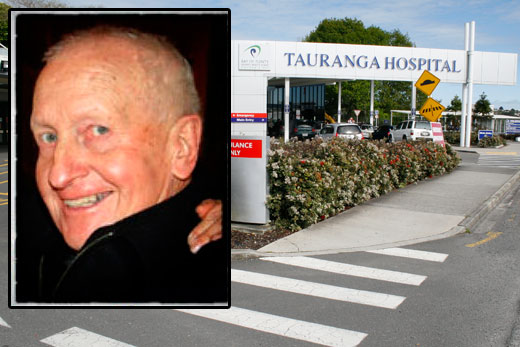
Significant and serious failings in the healthcare provided by Bay of Plenty District Health Board contributed significantly to the death of popular businessman Ian ‘Curly' Mcleod, a Coroner finds.
Serious concerns were raised about Curly McLeod's care by his family, but the family felt they were not being listened to by the DHB.
Serious failures in the way Tauranga Hospital treated Ian Mcleod leading to his premature death, a Coroner has found.
'Had proper actions been taken at that time, there would never have been an Inquest,” says Coroner Wallace Bain in a ruling released to media today.
'The family has pursued the matter, because they couldn't get any effective satisfaction to the concerns being raised about the deficiencies in the healthcare from the Bay of Plenty District Health Board.
'They had to go to the trouble of getting their own expert evidence, which at the inquest established the significant deficiencies in the standard of care.”
As a result of the two-day inquest the Coroner is recommending national changes in the way patients are assessed for and administered chemotherapy.
Ian Donald McLeod died at Waipuna Hospice in Tauranga on the October 15 2012.
Cause of death was acute pneumonia and chest infection against a background of colorectal adenocarcinoma – or colon cancer - with metastases to the liver.
But Coroner Bain said significant and serious failings in Curly's healthcare contributed significantly to his premature death.
Curly died because the portacath, an implanted device used to deliver chemotherapy drugs into a large veins inserted at Tauranga hospital in May 2011, had moved.
The change in location was seen in both X-rays and a CT scan, but the significance was not appreciated by radiology staff at Tauranga Hospital and it wasn't picked up by the oncologists.
'The significance of the portacath tip being in the azygos vein was not appreciated by the radiologist reporting the imaging and was either not noted, or not appreciated by the clinicians treating Mr McLeod's condition,” says the Coroner.
'It was thought by the clinicians, incorrectly, that his symptoms were due to an infection.
'There was a failure to correlate the imaging with the clinical picture and accordingly there was a delayed diagnosis of what his true medical position was. That disconnect between the clinical picture and the radiology imaging lead in the Court's view, based on the expert evidence before it, to the catastrophic delivery of chemotherapy into his trachea through the trachea-azygos fistula that had developed.
'It was there to be seen and this was not appreciated by the medical staff.”
A CT scan on August 10, 2012 showed the catheter in the azygos vein with no evidence of erosion through the vein wall into the trachea.
But on August 15 the oncologist reported that although Curly was coping with chemotherapy, he had lost five kilograms and he thought there was more going on.
Later in September Curly began coughing up blood in significant amounts and he was admitted to Tauranga Hospital with a suspected respiratory tract infection. The chest x-ray confirmed that the tip of the Portacath was sitting in the azygos vein. Curly was sent home the next day.
On September 19 he woke up coughing and bringing up large amounts of blood. He went to the Emergency Department of the hospital at 2:30am and further respiratory tract infection was suspected. The notes recorded a question as to whether chemotherapy should be held.
Later that day after further discussions with the medical team he was seemed okay to receive chemotherapy. There was no reference in the notes to the chest x-ray, or its results.
Curly was transferred to Waikato Hospital where there were discussions about the possibility of removing the Portacath, but it was decided surgery not be proceeded with.
On September 21, 2012 Curly told his family his concerns about the movement of the Portacath and they were recorded by his son Scott Mcleod and presented in evidence at the inquest.
Curly Mcleod wanted those concerns taken up with Tauranga Hospital to ensure the same problems did not occur in future with any other patient having a Portacath.
On the night of the 21 September Curly had a dramatic coughing fit at home. He coughed up a significant volume of blood and lost consciousness.
He was cared for at home and then transferred to Waipuna Hospice where he died on October 1, 2012.
Coroner Bain reports that problems were first noted in June 2012. In July Curly experienced pain during chemotherapy. A chest X Ray taken then showed the end of the portacath tubing had moved since the previous study.
Curly had developed a constant and persistent cough and his clinical notes in September show that he had been coughing for the last three months.
'The expert evidence on behalf of the family is quite unequivocal that due to his significant clinical symptoms he should not have been given a green light to proceed with chemotherapy on that day,” says the Coroner.
'As Mrs McLeod's evidence describes, once he was given chemotherapy the reaction was severe.”
In essence the chemotherapy drug was administered directly into Curly's lung because the Portacath had broken through the wall of the trachea from the azygos vein, causing a large fistula.
Coroner Bain recommends that hospital standard operating procedure should be available for the use of intravenous and central lines being used to deliver vesicant and irritating drugs especially chemotherapy. Such lines should not be used, unless they are in a position where blood is freely flowing.
Patients who are unwell should be medically assessed before each course of chemotherapy.
Radiologists should use more standardised template reports to ensure that all aspects of a plain x-ray, ultra sounds or CT scans are reported. Also, phrases such as 'position is unchanged' should be avoided.
He also recommends the protocol not only be accepted and implemented by Tauranga Hospital, but be applied nationwide.
And that the inter-departmental gaps in communication between emergency, radiology and oncology departments at Tauranga Hospital is established by the evidence in this case, be urgently addressed.
Coroner Bain is also concerned that in addition to inter-departmental communication failures, the family had put their concerns to the DHB after Curly's death.
They were very clear they wanted the hospital to make recommendations on new protocols and systems to guard against undetected migration of portacaths in the future. But a case review concluded it was a very rare event and no recommendations were made.
'Clearly the family were most unhappy with this,” says the Coroner.
'The evidence from Mrs Mcleod and the two sons raise many questions surrounding the events leading up to Mr McLeod's death and they wanted it clearly established the causes and circumstances leading to the tragic event that in their view killed their husband and father.
'Primarily however, they wanted recommendations to come from the Inquest that would reduce the chances of a similar event that occurred to Mr Mcleod happening in the future to someone else.”
BOPDHB general manager of Governance and Quality Gail Bingham says as noted by Coroner Wallace Bain in his findings, the "BOPDHB frankly acknowledged its deficiencies in these cases and has demonstrated that significant remedial action has been taken in their aftermath to ensure they could not happen again".
Copies of the findings are to be sent to The Director-General of Health, The Minister of Health, The Chief Executive of the Bay of Plenty District Health Board, and Chairman of the Board of the Bay of Plenty District Health Board.

3 comments
Doctors think they are above and beyond reproach.
Posted on 04-07-2014 16:47 | By CC8
Those are not the only departments at the Tauranga Hospital who do not communicate with each other. The entire hospital does not communicate effectively with patients or their carers either. My father nearly died because "specialists" in one field couldn't understand, or couldn't be bothered reading notes left by those dealing with a different health issue. When taken to task about it they ducked and dived and ran away from the issue.
Its clear to see
Posted on 04-07-2014 21:34 | By scottmss
This article clearly shows some of the problems: Gail Bingham is defending the actions and policies of the Hospital - her own departments task. The focus however is so wrong of this department, they should not have such a heavy focus on defence. What we need as a community and should expect of our hospital is a Governance and Quality department that is open and transparent with an approach that is looking to improve if possible. What we saw however was a very careful legal approach. An approach in my opinion that focused entirely on reducing any exposure for the DHB and where possible diverted any culpability. For me quality is Plan, Do, review, improve. what we saw was: plan, do, review, defend.
one
Posted on 04-07-2014 22:10 | By Capt_Kaveman
of out TCC councilors are on this board to so wonder what her comments are??
Leave a Comment
You must be logged in to make a comment.