


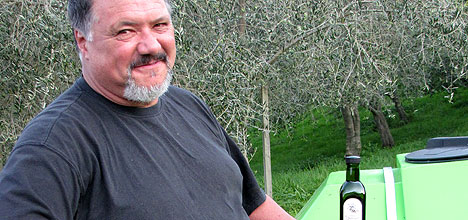
Onepu olive grower Eddie Smith's interest in growing olives came about almost by accident.
He was hitchhiking through Italy and France looking for casual work, and by sheer chance, a job was available in an olive grove.
Eddie Smith picks most of his olives by the end of July and leaves the oil to settle in tanks for up to two months.
Eddie worked on groves in Provence for a number of months, developing a close interest in olives and in 2001 he planted 3000 trees on his 7.8 hectare property on Braemar Road.
He harvests the crop from late April through to September and grows 10-15 tonnes a year.
'By September you are competing with birds who simply love olives,” says Eddie.
The average olive tree produces about 30kg when it reaches full production.
Eddie bottles his own olive oil and sells it to friends and at the Whakatane Farmers' Market. This year he's also thinking about selling it at the Rotorua Farmers' Market.
Olive varieties
He grows a number of French, Italian and Greek olive varieties including koroneiki, frantoio, picholine, pendolino, leccino, pichual, and moraiolo.
'If you have a variety you can vary the taste of them and have a range of colours and tastes.
'Most of mine are picked by the end of July and I leave the oil to settle in tanks for two months. Then they are bottled using the same methods as the Romans.”
In future he may consider preserving olives, but at this stage is more than happy to concentrate on producing quality oil.
'I may start infusing olive oil in the next few years as well. Kiwifruit and other crops are not on my agenda, but I wouldn't mind producing something like dried tomatoes along with the olives.” The olive groves he worked on in Europe are much older and bigger than their New Zealand equivalents and some of the trees Eddie saw in Provence were 100 years old with trunks about 60 centimetres wide.
In the right environment the trees can live for hundreds of years and Eddie says his grove will be there for at least another 50 years for someone else to ‘play with'.
Eddie says increasing numbers of New Zealanders are travelling overseas and getting to know more about olive oil and the tastes different varieties provide.
'People start to pick up on the flavours and good cooks know the varieties.”
Olive oils start to lose their taste notes after the first year and it is important to buy a product which has been bottled the same year, Eddie says. Easy sources of fresh oil are farmers' markets or the growers themselves.
'Many olive oils sold in supermarkets are bottled up to two years before they reach the shelves and are fine to be used as cooking oil, but are not as suitable for drizzling over salads, or using as a dipper for bread.”
When Eddie established his olive grove start-up costs were about $15,000 per hectare - a third of the cost of establishing kiwifruit. To learn more about the trees, he completed a course at Gisborne's Tairawhiti Polytechnic.
'There are so many different schools of thought about how you should plant them and how you should prune them.”
His trees are planted six metres apart on the diagonal.
'It works really well. It means we can turn the tractor around in any one row.”
Planting the trees this way also means each tree gets a fair share of the light.
Eddie says an interesting aspect of olive trees is that they close their stoma off at 30 degrees Celsius to preserve moisture.
'They tolerate the wet as long as the soil is free draining and there are good winds for drying and fertilisation. Olives are wind- pollinated and don't require bees.”
Thriving in the sun
Trees are best grown in high sunlight hours, with a PH of 6.5-7.1, with regular lime treatment to the soil and boron application. These days, boron can be sprayed onto the tree while applying copper to help prevent fungi.
Eddie maintains the grounds with a Landini tractor and a Trimax mower. Both were purchased from Jacks Machinery. His latest upgrade is a SprayRite trailed sprayer with a special boom for the trees.
'Previously I sprayed by hand but with the size of the operation, I had to move on up to the next step.
'It is important to get the right type of spray boom with spray patterns to suit the crop.”

0 comments
Leave a Comment
You must be logged in to make a comment.