


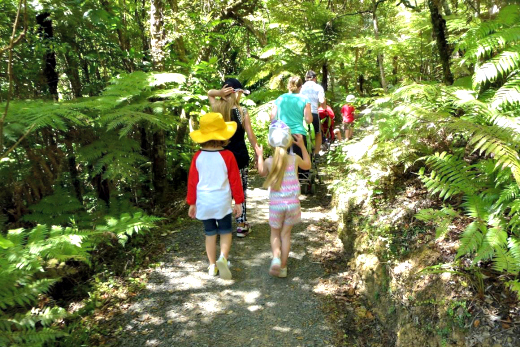
As a precautionary measure Coromandel's Long Bay Kauri Walk will be closed while soil samples are analysed to determine whether kauri dieback is present.
A symptomatic bleed on the iconic 1200-year-old tree which is situated adjacent to the track has been identified during a review of the use of cleaning stations at either end of the walk.
Coromandel's iconic Long Bay Kauri Walk will be closed temporarily after a symptom of kauri dieback was identified on a 1200-year-old tree. Photo: Lorraine Duffin/TCDC
The bleed was discovered by Waikato Regional Council biosecurity officer and national kauri dieback programme's operations team member Jeanie Allport.
'Soil samples have been taken as a precautionary measure,” says Jeanie. 'Due to the tree's situation to the track, and despite Thames-Coromandel District Council's efforts at trying to exclude visitors from walking up to the tree, it is evident that this is still occurring.
'In fact, as I was approaching the tree, two tourists were walking on its roots, touching the tree's trunk!
Jeanie adds: 'Given the close contact visitors have with this tree, and the symptomatic bleed, we have taken the precautionary approach and taken soil samples to establish whether or not kauri dieback disease is present.”
Kauri dieback is a disease which is spread through soil movement and only effects kauri and once the tree is infected it will eventually die.
There is no known cure.
There are infected trees on Great Barrier Island, Northland and Auckland and in two areas of the Coromandel.
To date, kauri dieback on the Coromandel is limited to two areas; the DOC-managed Hukarahi block near Whitianga and the Whangapoua catchment.
TCDC Parks and Reserves manager Derek Thompson, says the reserve at Long Bay is perfect for visitors to learn good behaviours regarding kauri dieback, with the cleaning stations and signage.
But he is disappointed not all visitors are heeding the advice to stay on the tracks and off the kauri roots.
Derek warns: 'Don't rely solely on cleaning stations being present at all track entrances.”
'The best action to take is to get into the habit of cleaning your boots and equipment before and after entering the bush.”
The district council opted to close the walk until the results from the soil sampling have been returned, which is expected to be in mid-March.
It is a precautionary approach and the results from the soil sampling will determine the future management of this walk.

0 comments
Leave a Comment
You must be logged in to make a comment.